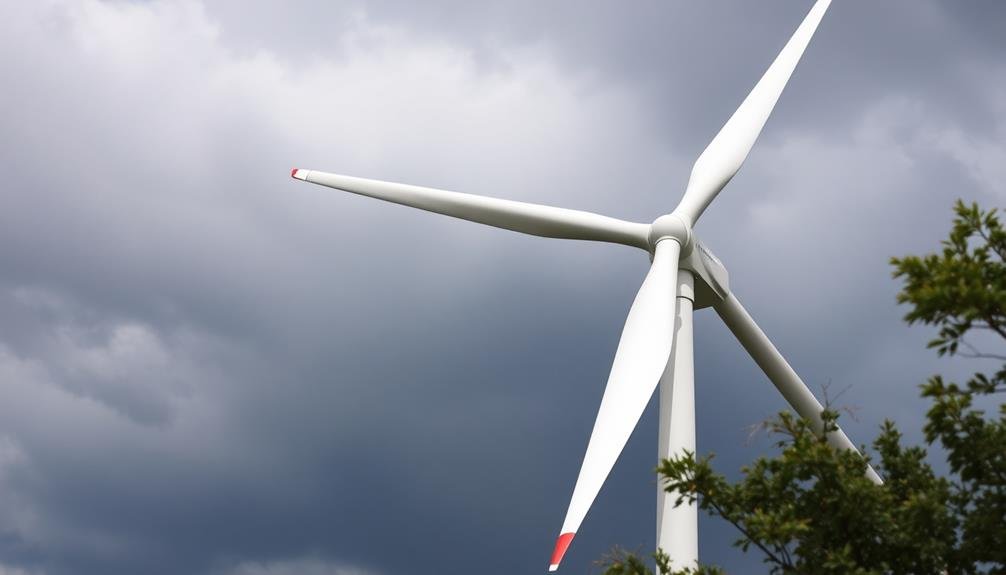
You can boost VAWT efficiency in gusty conditions through several key strategies. Optimize blade design with cambered airfoils and variable pitch mechanisms to adapt to changing winds. Implement adaptive control systems that adjust in real-time based on wind conditions. Consider augmented rotor configurations and wind deflectors to improve performance. Integrate wind speed forecasting to anticipate changes and adjust proactively. Multi-rotor VAWT arrays and energy storage solutions can help manage power output fluctuations. Don't forget about mitigating turbulence-induced vibrations for smoother operation. These approaches offer a solid foundation, but there's much more to explore in maximizing VAWT efficiency.
Blade Design Optimization

Three key factors drive blade design optimization for Vertical Axis Wind Turbines (VAWTs) in gusty conditions: airfoil shape, blade pitch, and solidity ratio.
When optimizing airfoil shape, you'll want to focus on profiles that maintain performance across a wide range of wind speeds. Cambered airfoils often outperform symmetrical ones in gusty conditions, as they provide better lift-to-drag ratios at varying angles of attack.
Blade pitch optimization involves finding the ideal angle between the blade chord and the rotor's plane of rotation. You'll need to take into account both fixed and variable pitch systems. While fixed pitch is simpler, variable pitch can adapt to changing wind conditions, potentially increasing efficiency in gusty environments.
The solidity ratio, which is the ratio of blade area to swept area, plays an essential role in VAWT performance. In gusty conditions, you'll generally want a lower solidity ratio to reduce drag and improve self-starting capabilities. However, you must balance this with the need for adequate torque production.
To optimize these factors, you'll need to employ computational fluid dynamics (CFD) simulations and wind tunnel testing. These tools will help you iterate designs and validate performance improvements in gusty conditions.
Variable Pitch Mechanisms
Variable pitch mechanisms' potential to enhance VAWT performance in gusty conditions can't be overstated. These systems allow the turbine's blades to adjust their angle relative to the wind, maximizing energy capture across varying wind speeds.
You'll find that this adaptability is particularly essential in gusty environments where wind direction and intensity fluctuate rapidly.
By implementing variable pitch, you're enabling your VAWT to maintain ideal angles of attack throughout its rotation. This results in increased torque and power output, even when wind conditions are less than favorable.
You'll notice improved self-starting capabilities and reduced stall occurrences, addressing common VAWT limitations.
However, you must consider the trade-offs. Variable pitch mechanisms add complexity and cost to your turbine design. You'll need to weigh these factors against the potential efficiency gains.
When designing your system, focus on robust, low-maintenance solutions that can withstand the stresses of frequent adjustments. Consider active control systems that use real-time wind data to fine-tune blade angles, maximizing energy capture in gusty conditions.
With careful implementation, variable pitch mechanisms can greatly boost your VAWT's performance in challenging wind environments.
Adaptive Control Systems
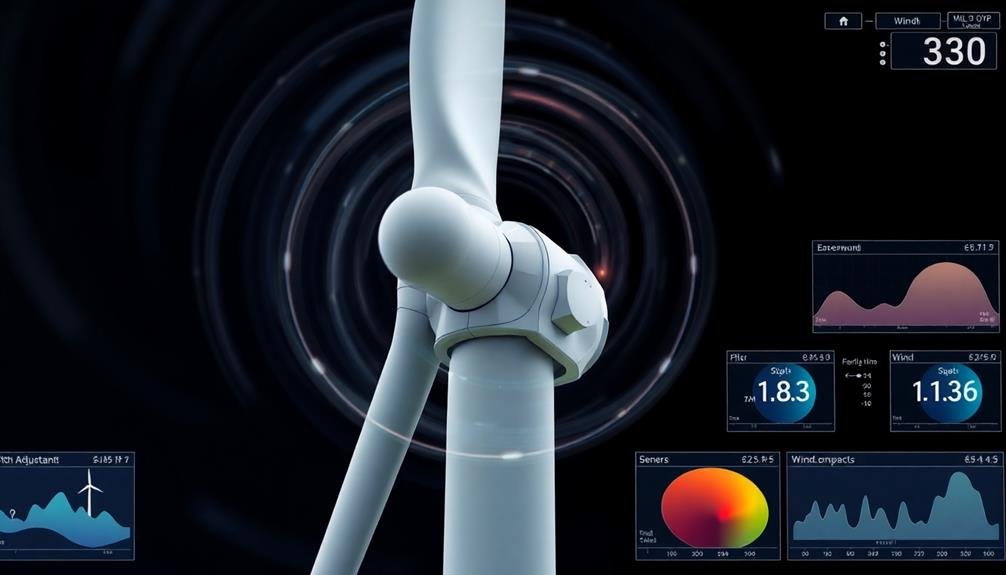
Building on the concept of variable pitch mechanisms, adaptive control systems take VAWT optimization to the next level. These intelligent systems continuously monitor wind conditions and turbine performance, adjusting various parameters in real-time to maximize efficiency.
You'll find that adaptive control systems use sensors to gather data on wind speed, direction, and turbulence. They process this information using advanced algorithms to make instant decisions about blade pitch, rotor speed, and generator load. This allows your VAWT to respond quickly to gusty conditions, maintaining peak performance even in rapidly changing environments.
Some key benefits you'll see from implementing adaptive control systems include increased energy capture, reduced mechanical stress on components, and improved overall reliability. They can also help mitigate noise issues by adjusting operation to minimize sound output in sensitive conditions.
When you're considering adaptive control systems for your VAWT, look for options that offer:
- Fast response times
- Robust sensor networks
- Machine learning capabilities
- Integration with existing SCADA systems
- Remote monitoring and control features
Augmented Rotor Configurations
Innovative augmented rotor configurations offer another avenue for improving VAWT efficiency in gusty conditions.
These designs modify the traditional VAWT structure to enhance performance in turbulent winds. You'll find that augmented rotors can increase power output and stability, making VAWTs more viable in urban and coastal environments.
One popular approach is the addition of guide vanes or shrouds around the rotor. These structures help direct and concentrate wind flow, increasing the turbine's effective swept area.
Another strategy involves using multiple rotors in various arrangements, such as stacked or side-by-side configurations. This can improve overall energy capture and reduce structural loads.
Consider these augmented rotor configurations for VAWTs:
- Diffuser-augmented VAWTs with specialized shrouds
- Dual-rotor systems with counter-rotating blades
- H-Darrieus rotors with added Savonius rotors for self-starting
- VAWTs with active blade pitch control mechanisms
Wind Deflectors and Concentrators
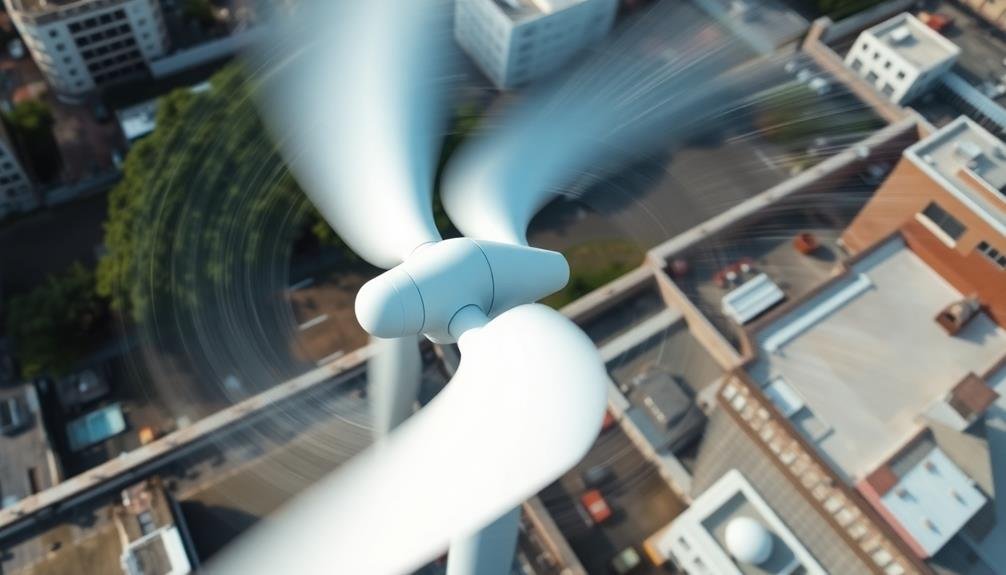
Wind deflectors and concentrators represent another approach to enhancing VAWT performance in gusty conditions. These devices are designed to funnel and direct wind flow towards the turbine, increasing the wind speed and improving overall efficiency.
You'll find that wind deflectors are typically stationary structures placed strategically around the VAWT. They're shaped to redirect incoming wind, channeling it towards the rotor blades. This can help maintain consistent wind flow even during gusty periods, reducing turbulence and improving the turbine's ability to capture energy.
Concentrators, on the other hand, work by funneling a larger area of wind into a smaller space. This concentration effect can greatly increase wind speed as it reaches the turbine. You'll often see concentrators in the form of shrouds or ducts surrounding the VAWT.
When you're dealing with gusty conditions, these devices can help stabilize wind flow and maintain more consistent turbine performance. They're particularly effective in urban environments where wind patterns are often unpredictable due to surrounding buildings and structures.
Torque Ripple Reduction Techniques
Turbines often face a common challenge: torque ripple. This fluctuation in torque can lead to decreased efficiency, increased wear on components, and unwanted vibrations.
To combat this issue in VAWTs, especially during gusty conditions, you can employ several torque ripple reduction techniques.
One effective approach is to optimize blade design. By carefully shaping the blades and adjusting their pitch, you can minimize torque variations throughout the rotation cycle.
Another method involves using multiple rotors with offset phases, which helps smooth out the overall torque output.
You'll find these additional techniques useful for reducing torque ripple:
- Implementing active pitch control systems
- Using advanced power electronics and control algorithms
- Incorporating energy storage devices to buffer fluctuations
- Designing flexible blade structures to absorb sudden gusts
Aerodynamic Stall Management

Stall prevention strategies play a crucial role in maintaining VAWT efficiency during gusty conditions. You'll want to focus on techniques that help the turbine adapt to rapid changes in wind speed and direction.
One effective approach is to implement variable pitch control systems. These allow the blades to adjust their angle of attack in real-time, optimizing performance across a wide range of wind conditions.
Another key strategy is to use blade designs that are inherently resistant to stall. You can achieve this by incorporating specialized airfoils with delayed stall characteristics. These profiles maintain lift at higher angles of attack, reducing the likelihood of sudden performance drops during gusts.
You should also consider employing active flow control methods. These include boundary layer suction or blowing techniques that can help maintain attached flow over the blade surface, even in challenging wind conditions.
Additionally, you can implement intelligent control systems that use sensors to detect imminent stall conditions and trigger appropriate responses, such as blade pitch adjustments or rotor speed modifications.
Structural Reinforcement Strategies
A crucial aspect of maintaining VAWT efficiency in gusty conditions is implementing effective structural reinforcement strategies.
You'll need to focus on strengthening key components to withstand variable wind loads and prevent structural failure. Start by reinforcing the turbine's base and foundation to guarantee stability during sudden gusts. Use high-strength materials and consider adding guy wires for additional support.
Next, pay attention to the rotor assembly. You should:
- Optimize blade design for increased strength without compromising aerodynamic performance
- Reinforce blade attachment points to prevent fatigue and failure
- Use lightweight, durable materials like carbon fiber composites for blade construction
- Implement shock-absorbing mechanisms to reduce stress on critical components
Don't forget about the tower structure.
You'll want to use a combination of rigid and flexible elements to absorb and dissipate wind-induced vibrations. Consider incorporating damping systems to minimize oscillations and reduce fatigue on structural components.
Bearings and Lubrication Improvements
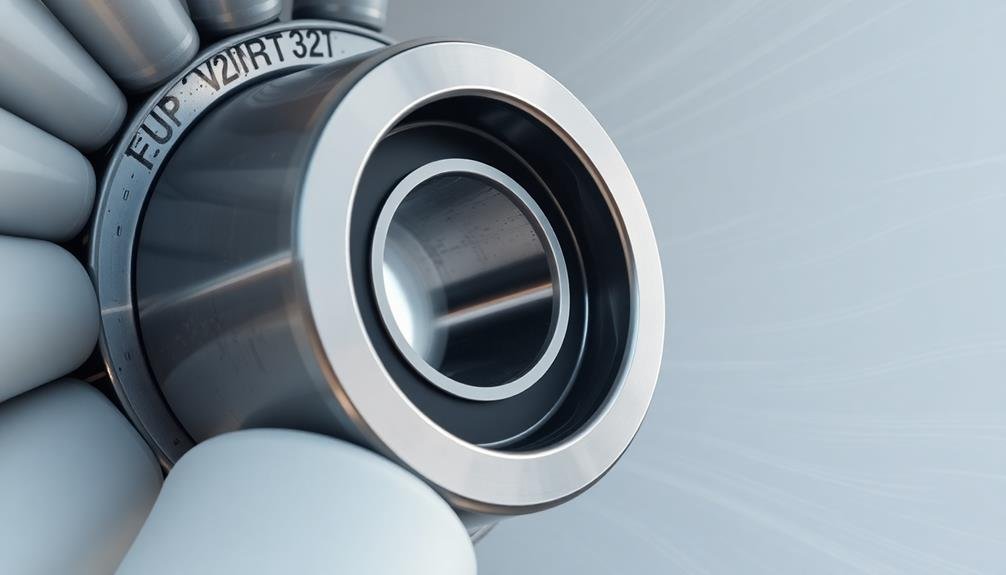
While structural reinforcement is vital, bearings and lubrication play an equally important role in maintaining VAWT efficiency during gusty conditions.
You'll find that high-quality bearings can greatly reduce friction, allowing your turbine to respond more quickly to sudden wind changes. Consider using ceramic bearings, which offer superior performance in harsh environments and can withstand higher temperatures.
Proper lubrication is essential to keep your bearings running smoothly. You should opt for synthetic lubricants that maintain their viscosity across a wide temperature range, ensuring consistent performance in varying weather conditions.
Don't forget to implement an effective sealing system to protect your bearings from dust, moisture, and other contaminants that can degrade their performance over time.
Regular maintenance is key. You'll want to inspect and clean your bearings periodically, replacing them when necessary.
Consider installing condition monitoring systems to track bearing performance in real-time, allowing you to detect and address issues before they lead to efficiency losses or turbine downtime.
Wind Speed Forecasting Integration
Integrating wind speed forecasting into your VAWT system can greatly enhance its performance in gusty conditions. By anticipating wind patterns, you'll optimize your turbine's operation and maximize energy output.
Advanced forecasting algorithms use real-time data and machine learning to predict short-term wind fluctuations with increasing accuracy.
You can implement wind speed forecasting in several ways:
- Install on-site meteorological stations to gather local wind data
- Utilize satellite and radar imagery for broader atmospheric insights
- Incorporate numerical weather prediction models
- Employ artificial neural networks for pattern recognition
With accurate forecasts, you'll adjust your VAWT's pitch, rotational speed, and load shedding in advance of gusty conditions.
This proactive approach reduces mechanical stress on components and prevents over-speeding. You'll also optimize power generation by preparing the system for upcoming wind bursts.
Multi-Rotor VAWT Arrays

Multi-rotor VAWT arrays offer a promising solution for maximizing energy capture in gusty conditions. By arranging multiple vertical axis wind turbines in a strategic layout, you'll increase overall efficiency and power output. These arrays can capitalize on wind fluctuations by allowing individual turbines to respond independently to changing wind directions and speeds.
You'll find that multi-rotor VAWT arrays have several advantages. They can be more compact than traditional single-rotor designs, making them suitable for urban or space-constrained environments. The array configuration also helps reduce wake effects, allowing downstream turbines to perform better.
Additionally, you'll benefit from increased reliability, as the failure of a single turbine won't completely halt energy production.
When designing a multi-rotor VAWT array, you should consider factors like turbine spacing, height variations, and rotation directions. Staggered layouts and counter-rotating turbines can enhance performance by minimizing interference and maximizing wind utilization.
You'll also want to optimize the control systems to guarantee each turbine operates at peak efficiency within the array. By carefully planning and implementing multi-rotor VAWT arrays, you can notably improve energy capture in gusty conditions, making wind power more viable in challenging environments.
Energy Storage Solutions
Batteries and flywheels play an essential role in harnessing the full potential of VAWTs in gusty conditions.
These energy storage solutions help smooth out power output fluctuations, ensuring a more consistent and reliable energy supply. You'll find that integrating storage systems with VAWTs can notably enhance their overall performance and grid compatibility.
When you're dealing with gusty winds, energy storage solutions offer several advantages:
- They capture excess energy during high wind periods, preventing waste
- They provide power during lulls, maintaining a steady output
- They improve grid stability by reducing sudden power surges or drops
- They enable VAWTs to participate in energy markets more effectively
You'll want to reflect on the specific characteristics of your VAWT installation when choosing an energy storage solution.
Batteries are excellent for long-term storage and can be scaled to meet various capacity needs. Flywheels, on the other hand, excel at rapid charge and discharge cycles, making them ideal for short-term power smoothing.
Turbulence-Induced Vibration Mitigation
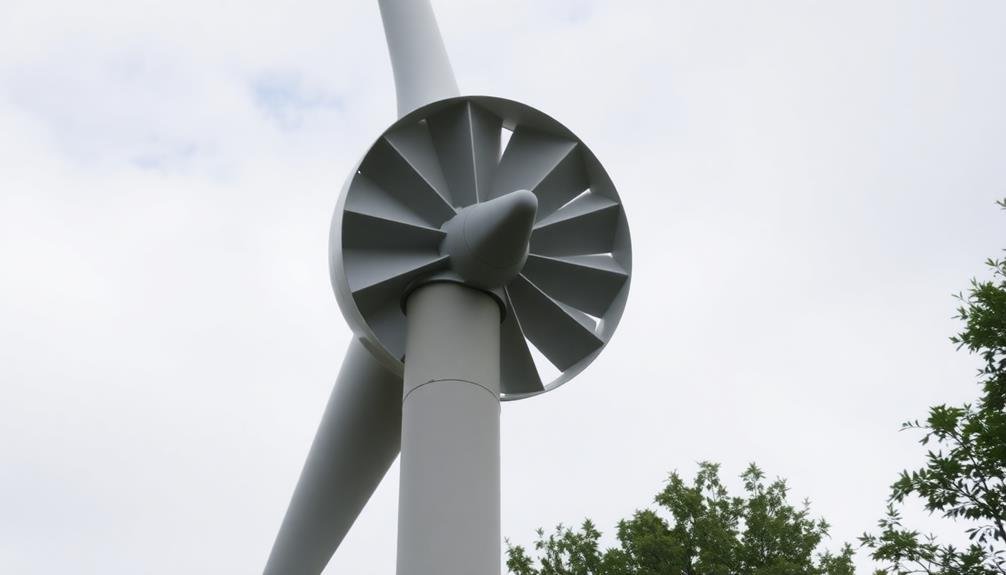
Addressing turbulence-induced vibrations is essential for maximizing VAWT efficiency in gusty conditions. You'll find that these vibrations can greatly reduce power output and increase wear on turbine components.
To mitigate these effects, you should consider implementing advanced damping systems. These systems absorb and dissipate vibrational energy, helping to stabilize the turbine structure.
You can also optimize blade design to reduce vibrations. Airfoils with lower sensitivity to angle of attack variations perform better in turbulent conditions. Additionally, you might employ active pitch control systems that adjust blade angles in real-time, responding to changing wind conditions and minimizing vibrations.
Another effective strategy is to use advanced materials in turbine construction. Composite materials with high strength-to-weight ratios and inherent damping properties can help absorb vibrations and reduce overall turbine weight.
You should also consider implementing smart structural health monitoring systems. These systems use sensors to detect and analyze vibrations, allowing for predictive maintenance and optimized turbine operation.
Frequently Asked Questions
How Do VAWTS Compare to HAWTS in Terms of Overall Efficiency?
You'll find that HAWTs generally have higher overall efficiency than VAWTs. They're better at capturing wind energy in steady conditions. However, VAWTs can perform better in turbulent winds and have some unique advantages in certain applications.
What Are the Typical Maintenance Requirements for VAWTS in Gusty Conditions?
You'll need to regularly inspect and lubricate bearings, check for blade damage, and tighten loose components. In gusty conditions, you should increase the frequency of these checks and guarantee the brake system is functioning properly.
Can VAWTS Be Used Effectively in Urban Environments With Unpredictable Wind Patterns?
Yes, you can use VAWTs effectively in urban environments with unpredictable winds. They're well-suited for turbulent airflow, require less space, and can capture wind from multiple directions. You'll find them increasingly popular on rooftops and in city planning.
What Is the Average Lifespan of a VAWT Operating in Gusty Conditions?
You'll find that a VAWT's lifespan in gusty conditions typically ranges from 15 to 20 years. However, it's important to highlight that regular maintenance and the quality of materials used can greatly affect this average lifespan.
How Do Noise Levels From VAWTS in Gusty Conditions Compare to Other Wind Turbines?
You'll find that VAWTs in gusty conditions generally produce less noise than horizontal-axis turbines. They're quieter due to their slower rotation speeds and lower blade tip velocities. However, specific noise levels can vary depending on design and wind conditions.
In Summary
You've explored various strategies to enhance VAWT efficiency in gusty conditions. By optimizing blade design, implementing adaptive control systems, and utilizing wind deflectors, you're on the right track. Don't forget the potential of multi-rotor arrays and energy storage solutions. Remember, it's not just about individual improvements but combining these technologies effectively. Keep innovating and testing to find the perfect balance for your specific wind environment. The future of VAWTs in turbulent conditions looks promising!