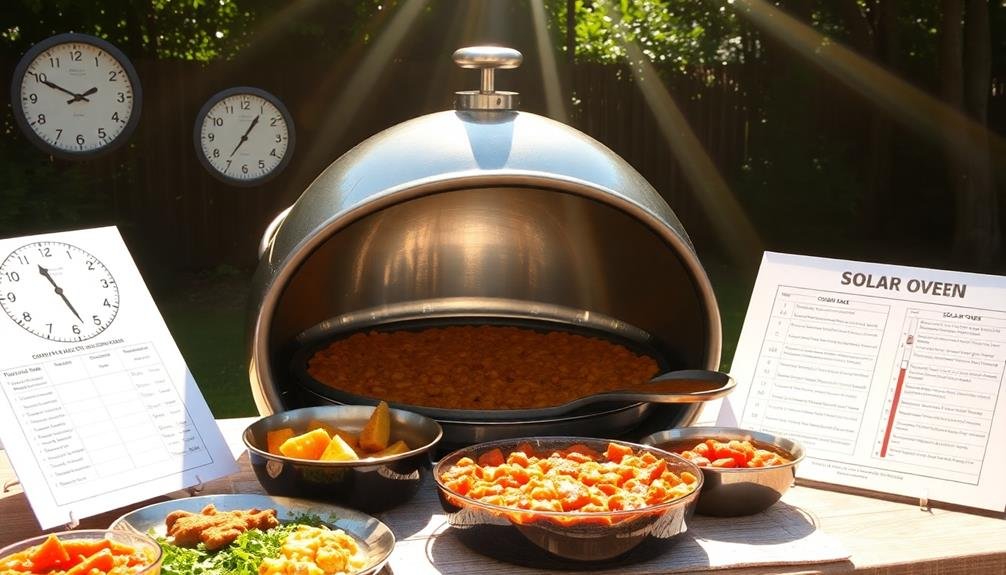
Solar oven cooking times vary widely, but these five essential charts will help you master the art. You'll find a basic chart for common foods like rice and beans, a meat and poultry guide for everything from chicken pieces to whole turkeys, and a vegetable and fruit timing chart that covers greens, roots, and stone fruits. There's also a baked goods guide for breads, cakes, and cookies, plus a dehydration timetable for preserving fruits, vegetables, and meats. With these charts, you'll confidently harness the sun's power to create delicious, eco-friendly meals. Discover how to optimize your solar cooking experience and reveal a world of culinary possibilities.
Basic Solar Oven Cooking Chart
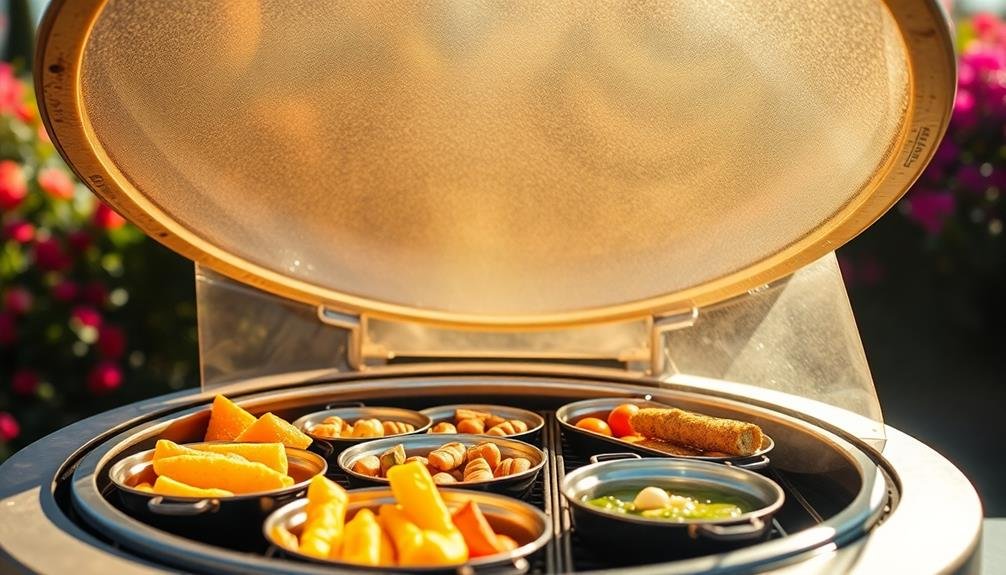
With the sun's rays as your heat source, cooking times in a solar oven can vary greatly depending on factors like sunlight intensity, outdoor temperature, and food quantity.
To help you plan your meals, here's a basic solar oven cooking chart for common foods:
- Rice: 1-1.5 hours
- Beans (pre-soaked): 2-3 hours
- Chicken pieces: 1.5-2 hours
- Fish fillets: 1-1.5 hours
- Vegetables (chopped): 1-1.5 hours
- Bread: 1-1.5 hours
- Cookies: 30-45 minutes
Remember, these times are estimates for a well-functioning solar oven on a clear, sunny day.
You'll need to adjust cooking times based on your specific conditions. It's best to start checking your food about halfway through the estimated cooking time and then every 15-30 minutes after that.
To guarantee food safety, always use a food thermometer to check that your dishes have reached the proper internal temperature.
Keep in mind that solar ovens typically cook at lower temperatures than conventional ovens, so foods may take longer to reach safe temperatures.
With practice, you'll become more adept at gauging cooking times for your favorite recipes.
Meat and Poultry Cooking Times
Building on our basic cooking chart, let's focus on meat and poultry solar oven cooking times. When cooking meats in a solar oven, you'll need to adjust your expectations and plan for longer cooking periods compared to conventional ovens.
For chicken pieces, aim for 1.5 to 2 hours of cooking time. Whole chickens typically require 3 to 4 hours, depending on size. Turkey breast will take about 2 to 3 hours, while a whole turkey needs 4 to 6 hours.
Beef roasts generally cook in 2.5 to 3.5 hours, with larger cuts requiring more time. Pork roasts follow a similar timeline.
For ground meats like beef or turkey, expect 1 to 1.5 hours of cooking time.
Fish fillets cook relatively quickly, usually in 1 to 1.5 hours. Whole fish may take up to 2 hours.
Vegetable and Fruit Solar Timings

Vegetables and fruits generally cook faster than meats in a solar oven, making them ideal for quick and healthy meals. Most veggies will be fully cooked within 1-2 hours, depending on their density and water content. Softer vegetables like zucchini, tomatoes, and bell peppers cook faster, while denser options like potatoes and carrots take longer.
For best results, cut your vegetables into uniform pieces to guarantee even cooking. You'll find that solar-cooked veggies retain more nutrients and flavor compared to traditional cooking methods. Fruits can be cooked in a solar oven too, creating delicious desserts or side dishes.
Here's a quick guide for common vegetables and fruits:
- Leafy greens (spinach, kale): 30-45 minutes
- Root vegetables (potatoes, carrots): 1.5-2 hours
- Stone fruits (peaches, plums): 45-60 minutes
Remember to check your food regularly, as cooking times can vary based on sunlight intensity and outdoor temperature. You'll know your vegetables are done when they're tender but not mushy. For fruits, look for a soft texture and caramelized edges.
Don't forget to season your dishes before placing them in the solar oven to enhance flavors.
Baked Goods Solar Cooking Guide
Baking in a solar oven offers a unique and eco-friendly way to create delicious treats. You'll find that most baked goods require less time in a solar oven compared to conventional ovens.
For bread, expect 1-2 hours of cooking time, depending on the size and type of loaf. Rolls and biscuits typically need 30-45 minutes.
When it comes to cakes, a standard 9-inch round cake will take about 1-1.5 hours. Cupcakes and muffins usually require 45-60 minutes.
For cookies, you're looking at 20-30 minutes, but keep an eye on them as they can brown quickly.
Pies and cobblers generally take 1.5-2 hours to bake thoroughly. If you're making a quiche or frittata, plan for about 1-1.5 hours of cooking time.
Remember that these times are approximate and can vary based on your solar oven's efficiency, outdoor temperature, and sunlight intensity.
To guarantee even baking, rotate your dish halfway through the cooking process. You'll know your baked goods are done when they're golden brown and a toothpick inserted in the center comes out clean.
Dehydration and Preservation Timetable
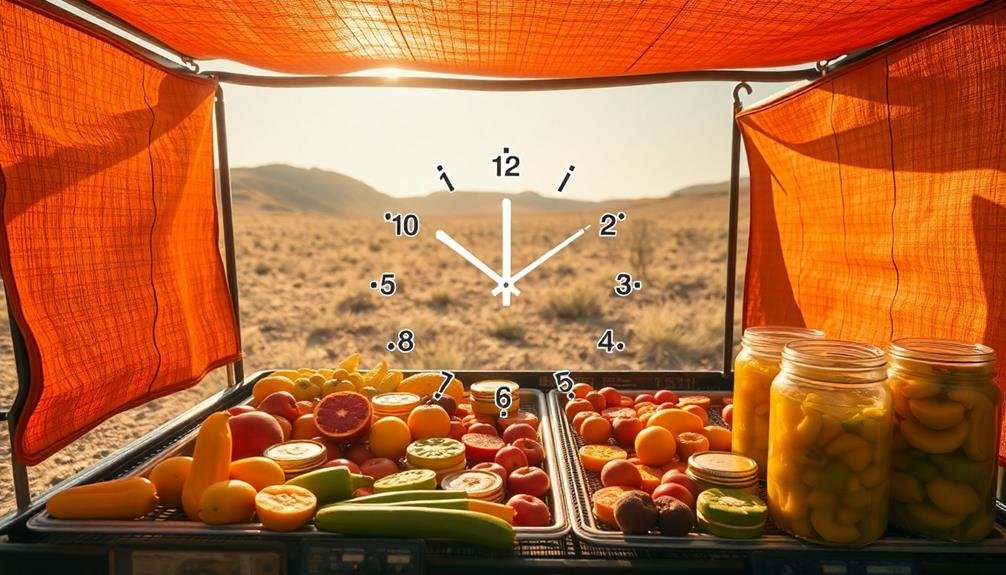
When it comes to dehydration and preservation in a solar oven, you'll find it's an efficient way to extend the shelf life of various foods. The process typically takes longer than conventional methods, but it's gentler on the food and preserves more nutrients.
For fruits, expect drying times between 6-12 hours, depending on the fruit's water content and thickness of slices. Vegetables usually take 8-14 hours, while herbs can be done in 2-4 hours.
To guarantee successful dehydration, follow these steps:
- Slice foods uniformly to guarantee even drying
- Arrange pieces in a single layer, not touching each other
- Rotate trays every few hours for consistent results
For preservation, you'll need to maintain temperatures between 115°F and 145°F. Meats require the highest temperatures and longest times, often 10-12 hours or more.
It's vital to monitor the process closely and use a food thermometer to guarantee safe preservation temperatures are reached and maintained. Remember, proper storage of your dehydrated and preserved foods is essential to maximize their shelf life.
Frequently Asked Questions
How Do Weather Conditions Affect Solar Oven Cooking Times?
Weather conditions greatly impact your solar oven cooking times. You'll find that sunny, clear days yield faster results. Cloudy or windy weather can slow cooking, while cooler temperatures may extend cooking times. Adjust your plans accordingly.
Can I Use My Regular Recipes in a Solar Oven?
Yes, you can use your regular recipes in a solar oven. However, you'll need to adjust cooking times and temperatures. Start by experimenting with shorter cooking times and lower temperatures. Be patient, as solar cooking often takes longer than conventional methods.
What Materials Are Best for Cooking Containers in Solar Ovens?
You'll want to use dark-colored, thin metal containers in your solar oven. They absorb heat better and cook food faster. Glass and ceramic work too, but they're slower. Avoid plastic and stick to materials safe for conventional ovens.
How Do I Adjust Cooking Times for Different Altitudes?
You'll need to increase cooking times at higher altitudes. For every 1,000 feet above sea level, add about 5% to your cooking time. Keep an eye on your food and use a thermometer to guarantee it's fully cooked.
Is It Safe to Leave Food in a Solar Oven Overnight?
It's not recommended to leave food in a solar oven overnight. You'll risk bacterial growth and food spoilage. Instead, you should remove and properly store your food once it's cooked. Always prioritize food safety when using solar ovens.
In Summary
You've now got the essential solar oven cooking time charts at your fingertips. Remember, these are guidelines, not hard rules. Weather, sun intensity, and your specific oven will affect cooking times. Don't be afraid to experiment and adjust as needed. With practice, you'll become a pro at solar cooking. Keep these charts handy, and you'll be whipping up delicious, eco-friendly meals in no time. Happy solar cooking!