
Tracking the sun with your solar cooker is essential for maximizing its performance. By aligning your cooker with the sun's position throughout the day, you'll capture more solar energy, maintain consistent cooking temperatures, and extend your cooking hours. This leads to faster cooking times, improved efficiency, and better-quality meals. Sun tracking also helps you adapt to seasonal changes and overcome geographical limitations, making your solar cooker more versatile year-round. Whether you choose manual adjustments or an automated system, following the sun's path guarantees you get the most out of your eco-friendly cooking device. Discover how sun tracking can transform your solar cooking experience and reveal its full potential.
Maximizing Solar Energy Absorption
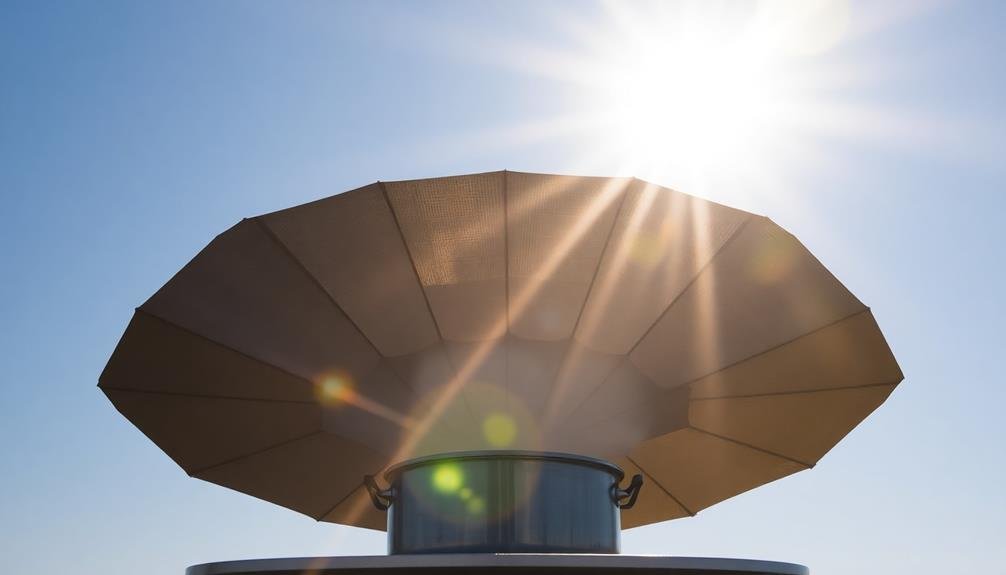
Efficiency is key when it comes to maximizing solar energy absorption for solar cookers. To get the most out of your solar cooker, you'll want to guarantee it's always facing the sun directly. This means adjusting its position throughout the day as the sun moves across the sky. By keeping your cooker aligned with the sun's rays, you'll capture more energy and maintain higher cooking temperatures.
The angle of your cooker's reflective surfaces is vital. You should position them to focus sunlight onto your cooking pot or oven. Experiment with different angles to find the best setup for your specific cooker design. Many solar cookers come with adjustable reflectors, allowing you to fine-tune their positions for maximum effectiveness.
Consider using a sun-tracking device or app to help you keep your cooker perfectly aligned. These tools can guide you in making small adjustments throughout the day, guaranteeing consistent energy absorption.
Additionally, choose cooking times that coincide with peak sunlight hours, typically between 10 AM and 2 PM. By combining these strategies, you'll greatly boost your solar cooker's performance and enjoy more efficient, eco-friendly cooking.
Consistent Cooking Temperatures
Along with maximizing solar energy absorption, maintaining consistent cooking temperatures is vital for successful solar cooking. By tracking the sun, you'll guarantee your solar cooker receives peak sunlight throughout the day, resulting in steadier heat levels for your food.
When you keep your cooker aligned with the sun's position, you'll avoid temperature fluctuations that can lead to undercooked or unevenly cooked meals. This consistency is important for dishes that require specific cooking times and temperatures, such as baked goods or slow-cooked stews.
Tracking the sun also helps you maintain the perfect temperature range for food safety. By keeping your cooker in direct sunlight, you'll reduce the risk of your food entering the "danger zone" where harmful bacteria can multiply rapidly.
Moreover, consistent temperatures allow you to better predict cooking times and plan your meals accordingly. You won't have to constantly adjust cooking durations or worry about sudden temperature drops affecting your food's doneness.
Extended Cooking Hours

One of the key benefits of tracking the sun for solar cookers is the significant extension of cooking hours. By continuously aligning your cooker with the sun's position, you'll be able to harness solar energy for longer periods throughout the day. This means you can start cooking earlier in the morning and continue well into the late afternoon or early evening.
Without sun tracking, your solar cooker's effectiveness would be limited to a few peak hours around midday. However, with proper tracking, you'll maximize your cooker's exposure to direct sunlight, effectively doubling or even tripling your cooking time. This extended window allows you to prepare more elaborate meals, slow-cook tough meats, or tackle multiple dishes in succession.
You'll also gain flexibility in meal planning. No longer constrained by a narrow cooking window, you can adapt your schedule to fit your daily routine. Whether you're preparing lunch for a large group or cooking dinner after work, sun tracking guarantees your solar cooker is ready when you need it.
This increased utility transforms your solar cooker from an occasional novelty into a reliable, everyday cooking appliance.
Improved Cooking Efficiency
Sun tracking greatly boosts the cooking efficiency of solar cookers. By following the sun's path across the sky, you'll guarantee that your cooker maintains ideal exposure to sunlight throughout the day.
This constant alignment maximizes the amount of solar energy captured and converted into heat, resulting in faster cooking times and higher temperatures.
When you track the sun, you'll notice significant improvements in your solar cooker's performance:
- Faster cooking times: Your meals will be ready sooner as the cooker maintains peak efficiency throughout the cooking process.
- Higher temperatures: You'll achieve and maintain higher cooking temperatures, allowing for a wider range of recipes and cooking methods.
- More consistent results: Sun tracking provides steady heat input, leading to more even cooking and better-quality dishes.
Adapting to Seasonal Changes
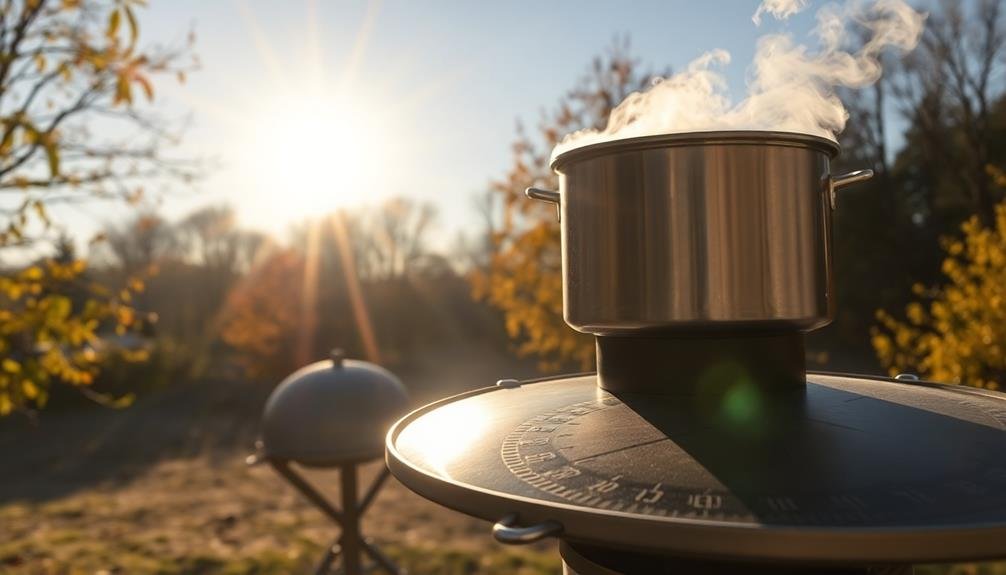
You'll need to adjust your solar cooker's position throughout the year to account for the changing angle of the sun.
By optimizing the cooker's orientation seasonally, you can maximize its exposure to sunlight and improve cooking efficiency.
Remember to take into account how the sun's path varies between summer and winter, as this will affect the ideal cooking times and the cooker's placement.
Adjusting for Sun Angle
Every season brings changes to the sun's angle in the sky, requiring adjustments to your solar cooker's position. To maintain peak efficiency, you'll need to adapt your cooker's angle throughout the year.
During summer, the sun sits higher in the sky, so you'll tilt your cooker more vertically. In winter, the sun's lower position means you'll need to adjust your cooker to a flatter angle.
To accurately adjust for sun angle:
- Observe the sun's position at solar noon (when it's highest in the sky)
- Use a sun angle calculator or smartphone app to determine the exact angle
- Adjust your cooker's reflective surfaces to match this angle
Optimizing Seasonal Cooking Times
Seasonal changes considerably impact solar cooking times and efficiency. To optimize your solar cooking throughout the year, you'll need to adapt your practices to the changing sun angles and daylight hours.
In summer, you'll have longer days and higher sun angles, allowing for extended cooking periods and faster meal preparation. You'll find it easiest to cook during midday when the sun is at its peak.
As autumn approaches, you'll notice shorter days and lower sun angles. You'll need to start your cooking earlier and may require more time to complete dishes.
Winter brings the biggest challenge, with the lowest sun angles and shortest days. You'll have to be strategic, positioning your cooker for maximum sun exposure and starting your meals earlier in the day. Insulation becomes essential to maintain heat.
Spring sees a gradual return to more favorable conditions. You'll be able to extend your cooking hours and enjoy increased efficiency as the days lengthen.
Throughout the year, you should adjust your cooking schedule and recipes to match the available sunlight. By understanding these seasonal patterns, you'll maximize your solar cooker's potential year-round.
Types of Sun Tracking Systems
You'll find two main approaches to tracking the sun for solar cookers: manual and automated systems.
Manual tracking methods require you to adjust the cooker's position periodically, ensuring it faces the sun throughout the day.
Automated tracking systems, on the other hand, use sensors and motors to continuously align the cooker with the sun's position, offering hands-free operation but at a higher cost.
Manual Tracking Methods
Manual tracking methods offer a simple yet effective approach to maximizing solar cooker efficiency. You don't need complex mechanisms or expensive equipment to keep your solar cooker aligned with the sun. Instead, you can use your own observations and make periodic adjustments throughout the day.
To manually track the sun:
- Position your cooker facing east in the morning, angling it slightly upward to catch the rising sun's rays.
- Every 30 to 60 minutes, rotate the cooker about 15 degrees to follow the sun's path across the sky.
- As the day progresses, gradually adjust the cooker's tilt to maintain ideal exposure to sunlight.
You'll find that these simple adjustments can greatly improve your solar cooker's performance. Pay attention to shadows cast by the cooker or its reflectors to gauge alignment. If you notice elongated shadows or decreased light concentration, it's time to reposition.
While manual tracking requires more attention than automated systems, it's cost-effective and allows you to fine-tune your cooker's position based on real-time conditions. You'll also gain a better understanding of solar movement patterns, enhancing your overall solar cooking experience.
Automated Tracking Systems
Automated tracking systems represent a notable leap forward in solar cooker technology. These systems use sensors and motors to continuously adjust your solar cooker's position, ensuring ideal sunlight exposure throughout the day.
You'll find two main types of automated trackers: single-axis and dual-axis systems.
Single-axis trackers move your cooker along one plane, typically east to west. They're simpler and more cost-effective but less precise than dual-axis systems.
Dual-axis trackers, on the other hand, move your cooker both horizontally and vertically, following the sun's path more accurately.
Most automated systems use light sensors to detect the sun's position. When the sensors detect a drop in light intensity, they activate motors to realign the cooker.
Some advanced systems incorporate GPS and astronomical algorithms to predict the sun's position, eliminating the need for sensors.
You'll also find hybrid systems that combine manual and automated tracking. These allow you to switch between modes, giving you flexibility and potentially reducing energy consumption.
While automated trackers are more expensive upfront, they can considerably increase your solar cooker's efficiency and convenience.
Building Your Own Tracking Mechanism
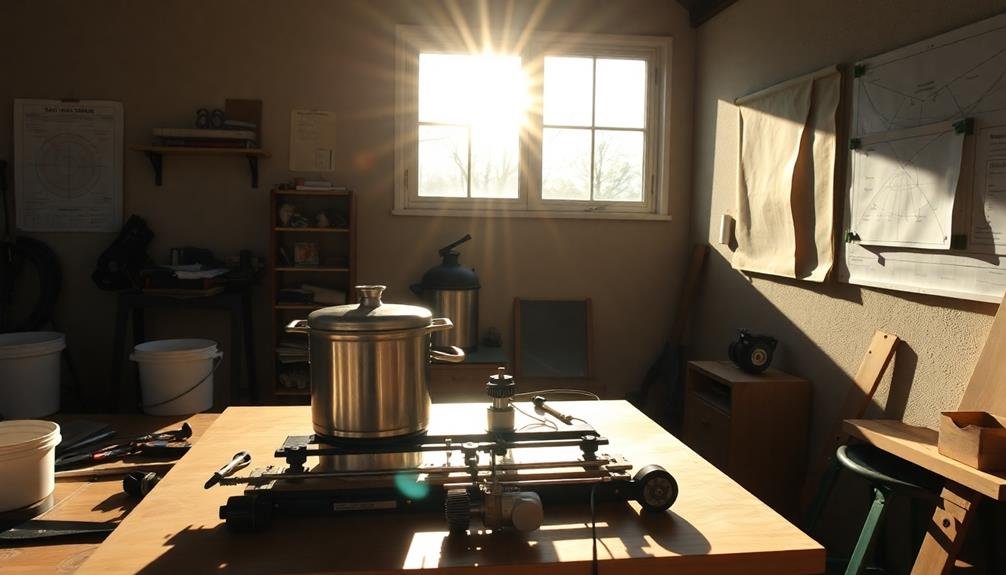
DIY enthusiasts and solar cooking aficionados can create their own tracking mechanism to enhance the efficiency of their solar cookers. By building a custom system, you'll gain a deeper understanding of solar tracking principles and save money compared to commercial options.
To construct your own tracking mechanism, start by designing a sturdy base that can support your solar cooker and rotate smoothly. Use materials like wood, metal, or PVC pipes, depending on your skill level and available resources.
Next, incorporate a drive system using a small motor, gears, and a timing belt to control the rotation. Finally, add a control unit with a microcontroller, such as an Arduino, to manage the tracking based on time or light sensors.
When building your tracking mechanism, consider these key aspects:
- Precision: Guarantee accurate alignment with the sun's position throughout the day
- Durability: Use weather-resistant materials to withstand outdoor conditions
- Adjustability: Design for easy calibration and maintenance
Automated Vs Manual Tracking
When considering tracking options for your solar cooker, you'll encounter two main approaches: automated and manual systems. Automated tracking uses sensors and motors to follow the sun's path, while manual tracking requires you to adjust the cooker's position periodically.
Let's compare these two methods:
| Aspect | Automated Tracking | Manual Tracking |
|---|---|---|
| Accuracy | High | Moderate |
| Initial Cost | Higher | Lower |
| Maintenance | Regular | Minimal |
| User Effort | Low | High |
| Power Source | Electricity/Battery | Human |
Automated systems offer precision and convenience but come at a higher cost. They're ideal if you're often away or want consistent performance. However, they require power and occasional maintenance.
Manual tracking is more affordable and simpler to set up. It's perfect for occasional use or if you enjoy hands-on involvement. You'll need to adjust the cooker every 15-30 minutes for peak performance.
Your choice depends on your budget, time availability, and personal preferences. If you're tech-savvy and value efficiency, automated tracking might be your best bet. If you prefer simplicity and don't mind the extra effort, manual tracking could be the way to go.
Overcoming Geographical Limitations

Geographical challenges can pose significant hurdles for solar cooker enthusiasts. However, tracking the sun can help you overcome these limitations and maximize your cooker's efficiency, regardless of your location.
If you're in a region with limited direct sunlight, tracking becomes even more essential. By following the sun's path, you'll be able to capture and utilize every available ray. This is especially beneficial in areas with:
- Mountainous terrain that creates extended periods of shade
- High latitudes where the sun's angle is lower on the horizon
- Frequent cloud cover that reduces overall sunlight exposure
Tracking also allows you to adapt to seasonal changes in the sun's path. As the Earth tilts on its axis, the sun's position in the sky shifts throughout the year. By adjusting your cooker's angle and orientation, you'll maintain ideal performance year-round.
Don't let your geographical location deter you from solar cooking. With proper tracking techniques, you can harness the sun's power effectively, even in challenging environments.
You'll be able to cook meals using clean, renewable energy while reducing your carbon footprint, no matter where you live.
Frequently Asked Questions
How Much Does a Sun-Tracking System for Solar Cookers Typically Cost?
You'll find sun-tracking systems for solar cookers vary widely in price. Basic manual trackers can cost as little as $50, while advanced automated systems may run up to $500 or more. It depends on the features you're looking for.
Can Sun Tracking Be Used With All Types of Solar Cookers?
You can use sun tracking with most solar cooker types, but it's especially beneficial for parabolic and box cookers. It's less essential for panel cookers. You'll get better performance and longer cooking times with tracking.
Are There Any Safety Concerns When Using Sun-Tracking Solar Cookers?
You should be cautious when using sun-tracking solar cookers. Watch for overheating, potential burns, and glare. Don't leave them unattended. Ascertain they're stable and won't tip over. Always follow the manufacturer's safety guidelines for best results.
How Often Should Sun-Tracking Mechanisms Be Maintained or Calibrated?
You should maintain and calibrate your sun-tracking mechanisms regularly. Check them monthly for accuracy and wear. Clean sensors, lubricate moving parts, and recalibrate if you notice misalignment. It's essential to guarantee peak performance and energy efficiency.
What Are the Space Requirements for Installing a Sun-Tracking Solar Cooker?
You'll need a clear, open area with unobstructed sunlight for your sun-tracking solar cooker. Plan for at least 10 square feet, considering the cooker's size and movement range. Don't forget space for maintenance and adjustments.
In Summary
You've now learned why tracking the sun is essential for your solar cooker. It's not just about maximizing energy; it's about enhancing your entire cooking experience. By following the sun, you'll enjoy consistent temperatures, longer cooking times, and better efficiency. Whether you choose automated or manual tracking, you're adapting to nature's rhythms. Don't let your location limit you. With sun tracking, you're revealing the full potential of solar cooking.


Leave a Reply