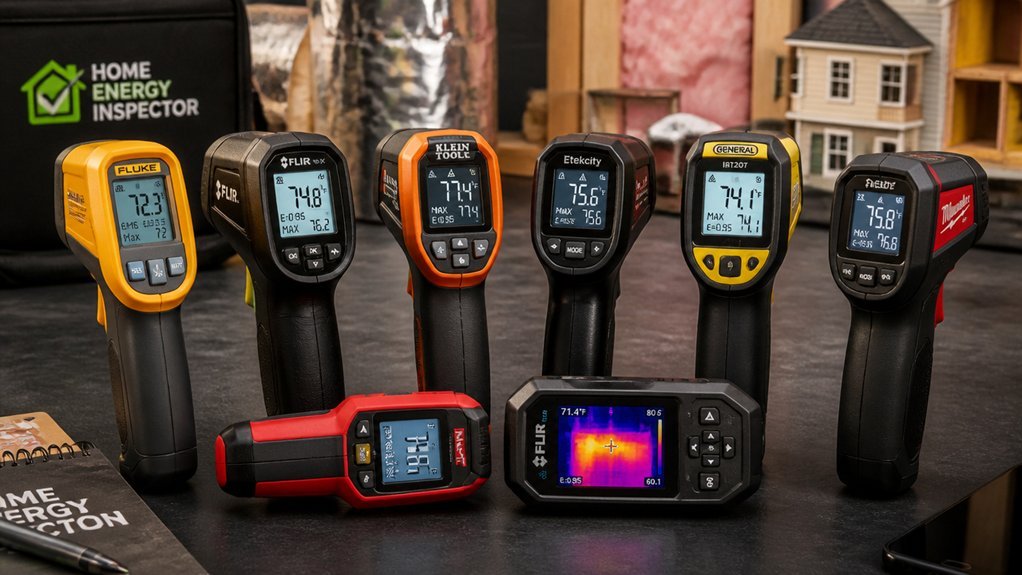
If you’re trying to track heat loss quickly and accurately, the right infrared thermometer can save you time and guesswork. In 2027, the best options offer sharper targeting, better distance-to-spot ratios, and features like adjustable emissivity or thermal imaging. Some are built for tough job sites, while others focus on home inspections and leak detection. The real difference may come down to one detail that most buyers overlook.
| Klein Tools IR1 Infrared Thermometer with Laser | 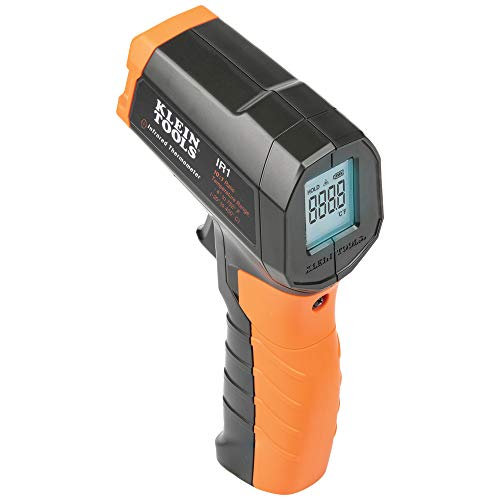 | Best Basic Pick | Measurement Type: Infrared thermometer | Non-Contact: Yes | Laser Aiming: Single laser | CHECK ON AMAZON | Read Our Analysis |
| Infrared Thermometer Gun with Color LCD |  | Best Feature-Rich | Measurement Type: Infrared thermometer | Non-Contact: Yes | Laser Aiming: 13-point laser | CHECK ON AMAZON | Read Our Analysis |
| Fluke 62 Max Infrared Thermometer (IP54 3-Year Warranty) |  | Most Durable | Measurement Type: Infrared thermometer | Non-Contact: Yes | Laser Aiming: Single laser | CHECK ON AMAZON | Read Our Analysis |
| Digital Infrared Thermometer Gun with Laser and Alarm |  | Best High-Heat | Measurement Type: Infrared thermometer | Non-Contact: Yes | Laser Aiming: Dual laser | CHECK ON AMAZON | Read Our Analysis |
| Raythink EX10 Pro Dual-Lens Thermal Camera (8G) |  | Best Thermal Camera | Measurement Type: Thermal camera | Non-Contact: Yes | Laser Aiming: Laser pointer | CHECK ON AMAZON | Read Our Analysis |
| GT14S Thermal Imaging Camera with Thermometer Mode | 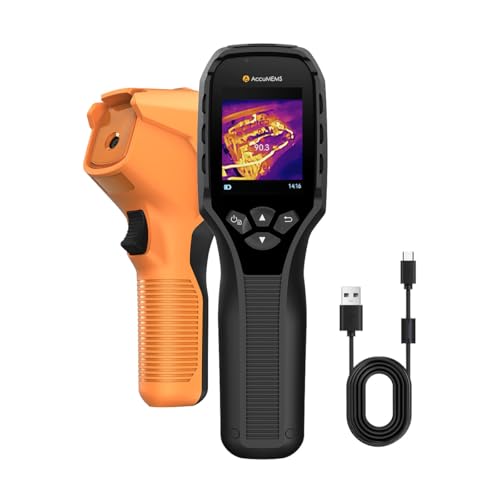 | Longest Battery Life | Measurement Type: Thermal camera | Non-Contact: Yes | Laser Aiming: Laser targeting | CHECK ON AMAZON | Read Our Analysis |
| BLACK+DECKER Thermal Leak Detector (TLD100) | 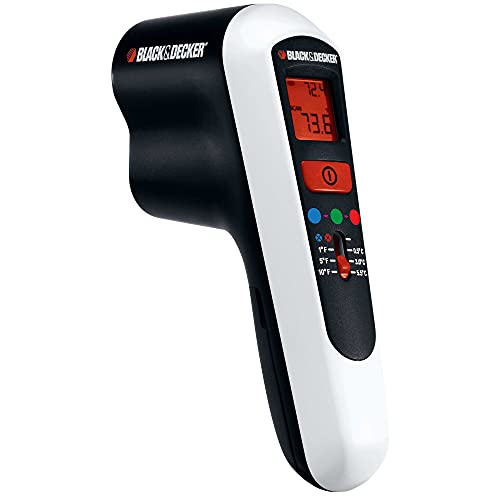 | Best For Home Leaks | Measurement Type: Infrared detector | Non-Contact: Yes | Laser Aiming: LED indicators | CHECK ON AMAZON | Read Our Analysis |
More Details on Our Top Picks
Klein Tools IR1 Infrared Thermometer with Laser
If you want a straightforward, reliable tool, the Klein Tools IR1 feels like a solid basic pick. You get a 10:1 distance-to-spot ratio, so you can check surfaces from a safe distance with decent precision. Its -4°F to 752°F range covers plenty of jobs, from HVAC checks to general home maintenance. The laser helps you aim quickly, and the backlit display makes readings easy in dim spaces. You’ll also like the auto power-off feature for battery savings. With fixed 0.95 emissivity, it delivers consistent results, but it’s not for people or animals.
- Measurement Type:Infrared thermometer
- Non-Contact:Yes
- Laser Aiming:Single laser
- Backlit Display:Backlit display
- Surface Temperature:Yes
- Auto Shutoff:Yes
- Additional Feature:Fixed 0.95 emissivity
- Additional Feature:10:1 distance-to-spot
- Additional Feature:-4°F to 752°F range
Infrared Thermometer Gun with Color LCD
For users who want a feature-packed temperature tool, this infrared thermometer gun stands out fast. You get non-contact laser sensing plus a K-probe for contact checks, so you can compare surface and interior readings quickly. The 13-point laser, adjustable emissivity, and 12:1 distance ratio help you aim accurately from safer distances. Its color HD VA display stays easy to read in dim spaces, and MAX/HOLD, unit switching, and auto-off improve convenience. You can monitor heat loss, cooking, HVAC, and hard-to-reach spots with confidence, though it’s best for inanimate objects.
- Measurement Type:Infrared thermometer
- Non-Contact:Yes
- Laser Aiming:13-point laser
- Backlit Display:Color LCD backlight
- Surface Temperature:Yes
- Auto Shutoff:Yes
- Additional Feature:K probe contact measurement
- Additional Feature:13-point laser guidance
- Additional Feature:24-month support service
Fluke 62 Max Infrared Thermometer (IP54 3-Year Warranty)
Built for rough job sites, the Fluke 62 Max is the most durable pick for industrial users. You can use it for non-contact surface checks on electrical, mechanical, HVAC, and automotive equipment, not for people. It measures from -22 to 932°F with ±1.5°C or ±1.5% accuracy across 0 to 500°C. The 10:1 distance-to-spot ratio and single laser help you aim precisely. You’ll see min, max, difference, and average readings on the backlit display. Its IP54 body resists dust and splashes, survives 3-meter drops, and carries a 3-year warranty.
- Measurement Type:Infrared thermometer
- Non-Contact:Yes
- Laser Aiming:Single laser
- Backlit Display:Backlit display
- Surface Temperature:Yes
- Auto Shutoff:Yes
- Additional Feature:IP54 dust protection
- Additional Feature:3-meter drop resistant
- Additional Feature:Min/max/difference/average readings
Digital Infrared Thermometer Gun with Laser and Alarm
DEASOMIYE’s laser-guided thermometer suits you when you need safe, precise readings from extreme heat. You can measure surface temperatures from -58°F to 2732°F, so it handles pizza ovens, furnaces, kilns, welding, forging, and open-flame cooking with ease. Its 50:1 distance-to-spot ratio lets you read targets four times farther than standard 12:1 models, while dual lasers improve aiming. The backlit LCD stays readable in low light, and the high/low alarm helps you spot problems fast. You also get max, min, and average readings, plus a 9V battery, toolbox, and 24-hour support.
- Measurement Type:Infrared thermometer
- Non-Contact:Yes
- Laser Aiming:Dual laser
- Backlit Display:Backlit LCD
- Surface Temperature:Yes
- Auto Shutoff:Yes
- Additional Feature:50:1 distance-to-spot
- Additional Feature:Dual laser pointers
- Additional Feature:High/low temperature alarms
Raythink EX10 Pro Dual-Lens Thermal Camera (8G)
Raythink’s EX10 Pro stands out if you need a best thermal camera for precise inspections. You’ll get 320×240 super-resolution imaging on a 2.8-inch screen, plus 40mK sensitivity that spots tiny 0.04°C differences. It measures from -4°F to 1022°F with ±2°C/±2% accuracy, and you can switch between Thermal, Visible, Fusion, and PIP views. The 2MP camera and laser pointer help you find faults fast. You’ll also monitor max, min, and center points, save data to 8GB storage, and work up to 10 hours in tough IP54 conditions.
- Measurement Type:Thermal camera
- Non-Contact:Yes
- Laser Aiming:Laser pointer
- Backlit Display:2.8-inch display
- Surface Temperature:Yes
- Auto Shutoff:Not stated
- Additional Feature:320×240 super resolution
- Additional Feature:8GB internal storage
- Additional Feature:9 color palettes
GT14S Thermal Imaging Camera with Thermometer Mode
If you need all-day thermal scanning, the GT14S stands out with the longest battery life. You can inspect heat loss with thermal imaging, Center/Hot/Cold spot views, and thermometer mode for quick point-and-shoot readings. Its high-sensitivity sensor detects tiny 0.05°C differences across -4°F to 1022°F, while adjustable emissivity and distance settings help you adapt to different materials. The 50° field of view speeds coverage, and high/low alarms flag problems fast. At just 240g, it’s easy to carry, and the 2500mAh battery lasts up to 14 hours. AccuMEMS backs it with a 1-year warranty.
- Measurement Type:Thermal camera
- Non-Contact:Yes
- Laser Aiming:Laser targeting
- Backlit Display:Screen display
- Surface Temperature:Yes
- Auto Shutoff:Not stated
- Additional Feature:NETD under 50mK
- Additional Feature:14-hour battery life
- Additional Feature:50° wide field
BLACK+DECKER Thermal Leak Detector (TLD100)
BLACK+DECKER’s TLD100 helps you spot hidden home leaks fast. You can scan around windows, doors, and vents to find power-draining drafts that raise heating and cooling costs. Its infrared sensor checks surface temperatures, so you can quickly locate warm and cool spots, and the LED switches blue or red to flag leaks. The LCD shows readings in Fahrenheit or Celsius, and the ergonomic grip feels secure in your hand. It isn’t for measuring people, but it can help you cut energy bills by up to 20% with its simple 5-step fix guide.
- Measurement Type:Infrared detector
- Non-Contact:Yes
- Laser Aiming:LED indicators
- Backlit Display:LCD display
- Surface Temperature:Yes
- Auto Shutoff:Not stated
- Additional Feature:Draft detection focus
- Additional Feature:Blue/red LED indicator
- Additional Feature:Energy savings up to 20%
Factors to Consider When Choosing Infrared Thermometers for Detecting Heat Loss
When you’re choosing an infrared thermometer for heat loss checks, look at its temperature range, distance-to-spot ratio, and emissivity settings first. You’ll also want a display that’s easy to read in dim spaces so you can spot trouble fast. Above all, make sure it offers solid measurement accuracy, since that’s what makes your results trustworthy.
Temperature Range
How wide should the temperature range be? You’ll want a thermometer that handles everything from sub-freezing conditions to moderately high heat, so you can spot both cold drafts and warmer leak points. A wide span, such as below 0°F to above 750°F, gives you enough flexibility to test walls, windows, ducts, and other building surfaces without swapping tools. Don’t settle for a narrow range, because it can hide the small temperature shifts that reveal heat loss. For the best results, choose a model that reads accurately around room temperature and below freezing, since those are the zones where inefficiencies often show up first. Make sure it also matches common building material temperatures, so you can measure every likely source of heat loss clearly and confidently.
Distance-to-Spot Ratio
Just as a wide temperature range helps you catch both cold spots and warmer leak points, the distance-to-spot ratio determines how accurately you can read those spots from afar. You want a higher D:S ratio when you need to measure from farther back without sacrificing precision. A 50:1 model, for example, can read a much smaller area at distance than a 10:1 or 12:1 unit. That matters when you’re checking tight, hot, or hard-to-reach areas for heat loss. Choose a ratio that keeps the spot smaller than the target so you don’t average in surrounding temperatures and blur the reading. With the right D:S ratio, you can identify leaks accurately while staying safely away from the surface.
Emissivity Settings
Emissivity settings matter because they determine how accurately your infrared thermometer reads different surfaces. You need to match the setting to the material you’re measuring, since emissivity describes how efficiently a surface emits infrared energy. Shiny metal can sit near 0.1, while matte black finishes can approach 1.0, and that gap changes your readings fast. If your thermometer lets you adjust emissivity, you can calibrate it for painted, oxidized, or coated surfaces and get better precision. A fixed-emissivity model usually assumes 0.95, which works on many common surfaces but can misread reflective ones. For heat loss checks, that adjustment helps you compensate for reflections and surface coatings, so you spot real temperature differences instead of measurement errors.
Display Visibility
When you’re checking for heat loss, a clear display can make all the difference, especially in dim basements, attics, or mechanical rooms. Look for a backlit screen so you can read temperatures without squinting in low light. A high-definition or colorful LCD helps you spot numbers fast, while sharper contrast makes information easier to interpret at a glance. Choose a model with a large display if you want to reduce mistakes during quick inspections. It also helps when the thermometer shows both Fahrenheit and Celsius, since that gives you more flexibility across jobs. Visual alerts, like color shifts or temperature alarms, can draw your attention to suspicious readings immediately, so you don’t miss areas that may be losing heat.
Measurement Accuracy
Accuracy matters because a good infrared thermometer should give you readings you can trust at a glance. You should check how the manufacturer states accuracy, usually as a percentage or a fixed margin like ±1.5% or ±1.5°C. That number tells you how close your reading is likely to be. Look for adjustable emissivity, too, because surfaces don’t all radiate infrared energy the same way, and the right setting improves results on different materials. A fast response time under 0.5 seconds helps you track changing surfaces more reliably. You’ll also want a strong distance-to-spot ratio, such as 50:1, so you can measure from farther away without picking up surrounding heat. For best results, aim carefully and keep conditions stable.
Alarm Functions
Alarm functions can make heat-loss inspections much faster because they alert you the moment readings cross a set high or low threshold. You can use these real-time warnings to spot cold drafts, insulation gaps, or overheated surfaces without staring at the display constantly. Models with high/low alarms help you notice abnormal readings quickly, which boosts safety and saves time during surveys. Some thermometers also include temperature-difference or spoilage alerts that flag readings far from ambient conditions, making hidden leaks easier to find. Audible beeps and visual indicators let you react fast in noisy or dim spaces. Look for adjustable alarm limits, so you can match the device to your target temperature range and your energy-saving goals.
Durability Rating
After you’ve looked at alert features, durability should be next on your list, especially if you’ll use the thermometer in basements, attics, job sites, or other rough spaces. Look for an IP54 rating or higher, so you know the tool can resist dust and water splashes. Check for drop resistance of at least 3 meters, because a tough housing matters when you’re moving fast or working at height. Rugged materials and a non-slip grip help you handle it comfortably and keep it protected over time. If you’ll use it in the field, choose a model that’s been tested for impact, moisture, and dust exposure. Battery life and auto power-off also matter, since they reduce wear and help the thermometer stay reliable longer.
Frequently Asked Questions
How Do Infrared Thermometers Differ From Thermal Leak Detectors?
You use infrared thermometers to measure a surface’s temperature, while thermal leak detectors help you spot insulation gaps and drafts by highlighting heat loss patterns. They’re different tools, though both reveal energy inefficiencies.
Can Infrared Thermometers Measure Heat Loss Through Windows Accurately?
You can estimate window heat loss with an infrared thermometer, but it won’t measure it accurately alone. You’ll get surface temperatures, not true heat flow. Drafts, reflectivity, and outdoor conditions can skew your readings substantially.
Do Emissivity Settings Affect Heat Loss Readings on Painted Surfaces?
Yes, you’ll see emissivity settings affect your readings on painted surfaces because paint changes how much infrared energy you detect. If you set emissivity wrong, you’ll misread surface temperature and underestimate or overestimate heat loss.
Are Thermal Cameras Better Than Infrared Thermometers for Finding Drafts?
Yes, you’ll usually find drafts faster with a thermal camera because it shows whole surfaces and temperature patterns. You can still use an infrared thermometer for quick spot checks, but it won’t reveal airflow as clearly.
How Often Should an Infrared Thermometer Be Calibrated?
You should calibrate your infrared thermometer at least once a year, and more often if you use it heavily, drop it, or notice odd readings. You’ll keep measurements accurate and reliable that way.