If you’re trying to keep indoor air healthier in 2027, a good CO2 monitor can make a real difference. The best models don’t just show numbers; they help you spot poor ventilation before it affects comfort or focus. From compact portable units to smart monitors with app alerts, each option offers something different. The tricky part is knowing which features matter most, and that’s where the comparisons get interesting.



More Details on Our Top Picks
Temtop CO2 Indoor Air Quality Monitor
Need a portable CO2 monitor? The Temtop CO2 Indoor Air Quality Monitor gives you continuous readings from 400 to 5000 PPM, plus temperature and humidity tracking. You get 1 ppm CO2 resolution and a 5-second refresh rate, so you can react fast to changing air. Its Swiss Sensirion SCD41 sensor delivers reliable accuracy, and the smart algorithm helps refine results. You can use it in nurseries, offices, grow tents, or schools. It runs up to 70 days in standby, but you’ll want it plugged in for nonstop monitoring. It doesn’t detect carbon monoxide.
- CO2 Range:400–5000 PPM
- Temperature:Yes
- Humidity:Yes
- Display:LCD display
- Alerts:Smart alert
- Power Source:USB powered
- Additional Feature:Swiss SCD41 sensor
- Additional Feature:5-second refresh rate
- Additional Feature:70-day standby life
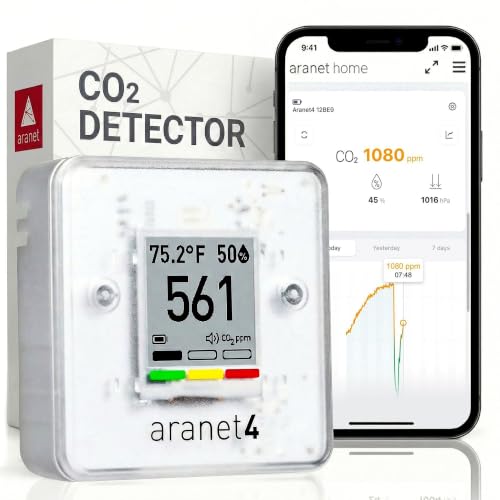
Aranet4 Indoor Air Quality Monitor with CO2 Sensor
If you want a CO2 monitor that runs for years, Aranet4 stands out. You’ll track CO2, temperature, humidity, and air pressure in real time with accurate NDIR sensing. Its wireless, cable-free design and e-ink display keep power use low, and the battery can last up to four years. You’ll see clear color coding, a large CO2 readout, and an optional buzzer if levels climb too high. The free app stores up to 90 days of data in graphs, helping you spot trends. Compact and made in the EU, it supports better focus, mood, and comfort.
- CO2 Range:Real-time CO2
- Temperature:Yes
- Humidity:Yes
- Display:E-ink display
- Alerts:Buzzer alert
- Power Source:Battery powered
- Additional Feature:Atmospheric pressure measurement
- Additional Feature:4-year battery life
- Additional Feature:90-day data history
GoveeLife Smart Air Quality Monitor CO2 Detector
GoveeLife’s Smart Air Quality Monitor suits you if you want a CO2 monitor packed with smart features. You get an SCD4x photoacoustic NDIR sensor with ±(40 ppm + 5%) accuracy, a 5-second refresh rate, and pressure compensation for altitude changes. It tracks CO2, temperature, humidity, and time on a customizable LED display. You can set day or night brightness, receive buzzer, app, and email alerts, and view two years of data in the app. It also works with Alexa, Google Assistant, humidifiers, and tower fans, while staying powered nonstop by AC.
- CO2 Range:Real-time CO2
- Temperature:Yes
- Humidity:Yes
- Display:LED display
- Alerts:Triple alerts
- Power Source:AC powered
- Additional Feature:Alexa voice queries
- Additional Feature:CSV report export
- Additional Feature:Humidifier automation support
Air Quality Monitor with CO2 TVOC and PM2.5
For anyone who wants one compact monitor to track multiple indoor pollutants, this multi-sensor option stands out. You get real-time readings for CO2, TVOC, formaldehyde, PM2.5, PM1.0, PM10, temperature, humidity, and AQI in one portable device. The high-definition color screen uses a three-color alert system, so you can spot rising pollution fast. Its smart chip and advanced sensors help keep readings stable and accurate, while Bluetooth time calibration adds convenience. Use it in bedrooms, offices, cars, kitchens, or basements, and switch settings easily with simple button controls.
- CO2 Range:Real-time CO2
- Temperature:Yes
- Humidity:Yes
- Display:Color screen
- Alerts:Audible alarm
- Power Source:Unknown
- Additional Feature:Monitors PM1.0
- Additional Feature:Monitors HCHO and TVOC
- Additional Feature:Bluetooth time calibration
SwitchBot CO2 Air Quality Monitor
SwitchBot’s Meter Pro CO2 is ideal when you want a clear, all-in-one indoor air reading at a glance. You get a large 92mm display that shows CO2, temperature, humidity, time, date, and comfort level at once. Its Swiss-made NDIR sensor checks air every second with ±50 ppm accuracy across 400 to 9,000 ppm. You can set custom alerts for CO2, heat, and humidity, then get sound, screen, or app warnings. Its compact build, 12-month battery, and flexible mounting make it easy to use anywhere, from bedrooms to greenhouses.
- CO2 Range:400–9000 ppm
- Temperature:Yes
- Humidity:Yes
- Display:Large screen
- Alerts:Threshold alerts
- Power Source:Battery powered
- Additional Feature:92mm display screen
- Additional Feature:Swiss-made NDIR sensors
- Additional Feature:Wall-mount holes
10-in-1 Air Quality Monitor with Real-Time Display
If you want one monitor that tracks nearly everything, this 10-in-1 model fits the bill. You can check PM0.3, PM2.5, PM10, CO2, CO, HCHO, TVOC, AQI, temperature, and humidity in real time, so you get a full picture of your air. Its color display makes Good-to-Serious levels easy to read at a glance. The sensor array refreshes every 1.2 seconds, helping you catch cooking smoke or ventilation changes fast. You also get audible alerts, one-button control, and no app setup. With a 2000mAh battery, it runs up to 96 hours.
- CO2 Range:Real-time CO2
- Temperature:Yes
- Humidity:Yes
- Display:Color screen
- Alerts:Audible alarm
- Power Source:Rechargeable battery
- Additional Feature:Monitors CO and HCHO
- Additional Feature:1.2-second sampling
- Additional Feature:96-hour battery life
CO2 Monitor for Home Air Quality Detector
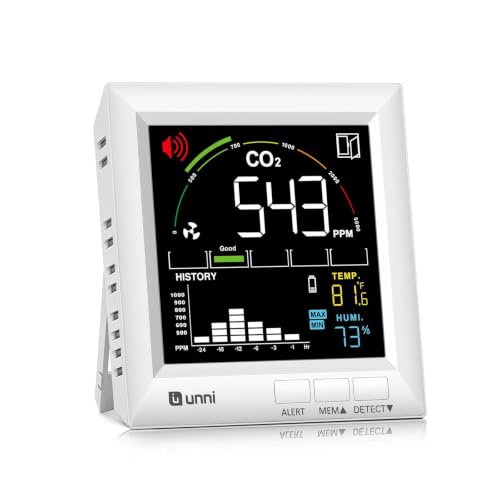
This CO2 monitor is a smart budget pick for keeping tabs on home air quality. You’ll see real-time CO2, temperature, and humidity readings on its display, plus history charts and max/min data. It tracks 400 to 5000 PPM with ±5% + 50 PPM accuracy, so you can spot stale air fast. The Swiss-made Sensirion photoacoustic sensor helps deliver reliable results. You can set three alarm volumes and three brightness levels, and it runs on USB or AAA batteries. Mount it on a wall or place it on a table.
- CO2 Range:400–5000 PPM
- Temperature:Yes
- Humidity:Yes
- Display:Multi-brightness display
- Alerts:Adjustable alarm
- Power Source:USB powered
- Additional Feature:History chart display
- Additional Feature:Three alarm volumes
- Additional Feature:AAA battery backup
Factors to Consider When Choosing CO2 Monitors for Better Indoor Air
When you choose a CO2 monitor, check its measurement range and make sure it covers the levels you expect indoors. You’ll also want strong sensor accuracy, a fast refresh rate, and extra air metrics like temperature or humidity if you want a fuller picture. Alert options matter too, since they help you react quickly when CO2 levels rise.
CO2 Measurement Range
CO2 measurement range matters because you want a monitor that can handle both normal background levels and dangerous spikes in indoor air. Most indoor air quality monitors read from about 400 ppm, which matches outdoor background air, up to 5,000 ppm or more. That wide span lets you track everyday changes and catch buildup in crowded, stuffy rooms before air quality slips. If you work in a greenhouse, grow room, or industrial space, look for a monitor that goes beyond 5,000 ppm so it can handle extreme conditions too. When you choose a range that fits your space, you’ll spot ventilation problems sooner and respond faster with fresh air or other fixes.
Sensor Accuracy
Accuracy matters because a CO2 monitor is only useful if you can trust the numbers it gives you. Check the spec for both a fixed error, like ±40 ppm or ±50 ppm, and a percentage of the reading, such as ±5%, since that tells you how the device performs at different levels. NDIR and photoacoustic sensors usually give the most dependable results, and photoacoustic models can update quickly. You should also look for calibration features, because even a good sensor can drift over time. Expect the best precision in the mid-range, around 400–2500 ppm, where most indoor readings sit. At very high concentrations, accuracy can slip. Compensation for pressure or altitude can help you get more reliable readings when your environment changes.
Refresh Rate
Refresh rate matters because it tells you how quickly a CO2 monitor updates its reading, usually every 1 to 5 seconds. When you choose a faster model, you can spot rising CO2 levels sooner and respond with ventilation before stuffiness builds. That quick feedback helps you manage indoor air more effectively, especially in rooms where people come and go often. Slower monitors can leave you waiting too long for alerts, which can delay action when air quality drops. Look for devices that balance rapid updates with dependable performance, since frequent readings demand capable sensor design. If your space changes throughout the day, a quick refresh rate gives you current information, so you can keep conditions more comfortable and better controlled.
Extra Air Metrics
Beyond carbon dioxide, extra air metrics can give you a fuller picture of what’s going on indoors. When you choose a monitor that tracks temperature and humidity, you can judge comfort and spot conditions that may encourage mold growth. Adding TVOCs helps you notice chemical pollutants from cleaners, paint, or furniture, while PM2.5 and PM10 readings reveal fine particles from dust, smoke, and outdoor pollution that CO2 alone can’t detect. Some models also measure formaldehyde for an even deeper check. With multiple metrics, you can see how ventilation affects air quality, health, and comfort at the same time. You’ll also get historical data that helps you connect CO2 spikes with other pollutants, so you can make smarter changes to your indoor environment.
Alert Options
When you’re choosing a CO2 monitor, alert options matter because they tell you right away when indoor air needs attention. Look for monitors that use more than one warning style, such as a buzzer, screen notice, or smartphone alert, so you don’t miss a spike. You should also be able to set the CO2 threshold to match your room, whether it’s a busy office or a quieter bedroom. If you’ll use it in a nursery or sleep space, adjustable volume and brightness help keep alerts noticeable without being disruptive. Real-time notifications matter because they let you ventilate quickly, which can cut headaches, drowsiness, and foggy thinking. With continuous monitoring and instant warnings, you can respond fast and keep indoor air healthier.
Power Source
Power source plays a big role in how and where you use a CO2 monitor. If you need flexibility, choose a battery-powered model. Rechargeable or replaceable batteries let you move it easily, and long-lasting batteries can keep working for months or even years when outlets aren’t nearby. USB-powered monitors give you another option: you can plug them in for steady use, then rely on backup battery power when you need portability. If you want the simplest setup, wireless battery-operated units cut the cord and keep installation easy, though you’ll need to recharge or swap batteries now and then. For spaces that demand nonstop tracking, continuous AC power is the safest pick because it keeps your monitor running without interruption.
Data History
Data history helps you spot patterns in indoor air quality over days, weeks, or months, so you can connect CO2 spikes to things like occupancy or poor ventilation. You can use that insight to time ventilation better and keep fresh air flowing when it matters most. Many monitors store 90 days to several years of readings, giving you a long view of how your space changes. Look for models with apps that turn logs into clear graphs and charts, so you can compare trends without digging through raw numbers. If you want deeper insight, choose a monitor that lets you export data for health tracking, building management, or energy-efficiency reviews. That record can guide smarter choices and improve indoor air consistently.
Portability Options
Portability matters if you want to move a CO2 monitor between rooms or use it in changing spaces like homes, offices, classrooms, or vehicles. You should look for a lightweight, compact unit that’s easy to carry and reposition when your needs change. Battery power or long battery life helps you monitor air quality without hunting for an outlet, which is especially useful in temporary setups or moving spaces. Flexible mounting options, such as wall brackets or a stand, let you place the monitor where it fits best. You can also benefit from adjustable display brightness and customizable audio alerts, since they help you match the device to quiet offices, busy classrooms, or low-light areas without causing unnecessary disruption.
Frequently Asked Questions
How Often Should a CO2 Monitor Be Calibrated?
You should calibrate your CO2 monitor every 6 to 12 months, or sooner if readings drift. Follow the manufacturer’s schedule, and you’ll keep measurements accurate and your indoor air decisions reliable.
What CO2 Level Indicates Poor Indoor Air Quality?
Poor indoor air quality usually shows up when your CO2 level rises above 1,000 ppm. You’ll likely notice stuffiness, reduced alertness, and more discomfort; above 1,500 ppm, ventilation probably isn’t enough.
Can CO2 Monitors Detect Mold or Allergens?
No, you can’t rely on CO2 monitors to detect mold or allergens. They only measure carbon dioxide levels. You’ll need separate air-quality sensors, humidity checks, or professional testing to identify those hidden pollutants accurately.
Where Is the Best Place to Install a CO2 Monitor?
You should place your CO2 monitor at breathing height, away from windows, vents, doors, and direct sunlight. Mount it in a central, occupied room for accurate readings, and don’t hide it behind furniture.
Do Battery-Powered CO2 Monitors Need Frequent Charging?
No, you usually don’t need to charge them often; many battery-powered CO2 monitors run for weeks or months. You’ll charge them more often if you use backlit screens, alerts, or continuous wireless syncing.