
When choosing a top pellet stove, look for efficiency ratings of 70% or higher and EPA certification. The Harman P68, Quadra-Fire Mt. Vernon AE, and Castle Serenity are highly rated options, each offering unique features. Consider your heating needs, space, and budget when selecting. For proper installation, make sure you have a non-combustible floor pad, correct clearances, and a proper venting system. Don't forget to factor in fuel quality, as it greatly impacts performance. Regular maintenance is essential for peak operation. By understanding efficiency ratings, installation requirements, and maintenance needs, you'll be well-equipped to make an informed decision on your ideal pellet stove.
Understanding Pellet Stove Efficiency Ratings
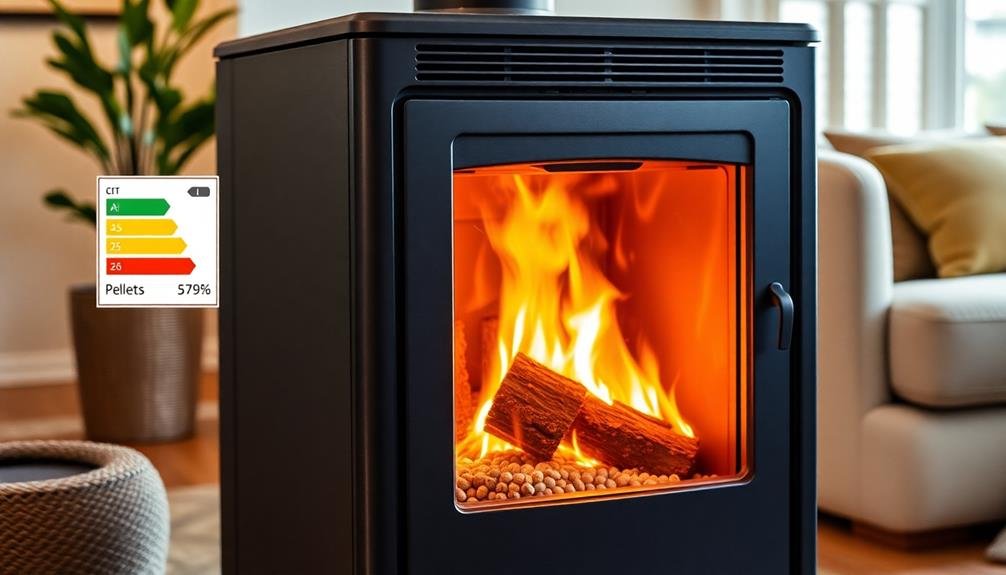
Efficiency is the cornerstone of pellet stove performance. When you're considering a pellet stove, understanding its efficiency rating is vital. This rating, typically expressed as a percentage, indicates how much of the fuel's energy is converted into usable heat. The higher the percentage, the more efficient the stove.
You'll often see two types of efficiency ratings: steady-state and annual fuel utilization efficiency (AFUE). Steady-state efficiency measures the stove's performance at its ideal operating temperature, while AFUE considers factors like start-up and cool-down periods. Look for stoves with efficiency ratings of 70% or higher.
To interpret these ratings, remember that a 90% efficient stove will convert 90% of the pellets' energy into heat, with only 10% lost. This translates to lower fuel consumption and reduced operating costs.
However, don't solely focus on efficiency. Consider factors like heat output, which is measured in BTUs (British Thermal Units), to confirm the stove can adequately heat your space. Also, check for EPA certification, as this guarantees the stove meets strict emission standards, further enhancing its overall efficiency and environmental impact.
Top-Rated Pellet Stoves
When you're in the market for a pellet stove, you'll want to contemplate the top-rated models.
You can start by examining the best-selling units from reputable manufacturers, focusing on their efficiency ratings and customer reviews.
To make an informed decision, compare the performance metrics of different models, including heat output, fuel consumption, and emissions levels.
Best-Selling Models
Three top-rated pellet stoves have consistently dominated the market due to their efficiency, reliability, and user satisfaction.
The Harman P68 leads the pack with its advanced technology and impressive 78% efficiency rating. It's equipped with an auto-ignition system and can heat spaces up to 3,900 square feet, making it ideal for large homes.
Coming in second is the Quadra-Fire Mt. Vernon AE, boasting a 76% efficiency rating and a user-friendly digital control panel. You'll appreciate its ability to burn multiple fuel types, including corn and wheat, giving you flexibility in fuel choices.
The Castle Serenity rounds out the top three with its compact design and budget-friendly price point. While it has a slightly lower efficiency rating of 69.8%, it's still a solid choice for smaller spaces up to 1,500 square feet.
You'll find its simple controls and easy maintenance appealing if you're new to pellet stoves.
When choosing among these best-selling models, consider your heating needs, available space, and budget. Each offers unique features that cater to different preferences, ensuring you'll find the perfect fit for your home.
Performance Comparisons
Now that you're familiar with the top-selling models, let's examine how they stack up against each other in real-world performance.
When comparing pellet stoves, it's essential to take into account factors beyond just heat output. Efficiency, fuel consumption, and ease of maintenance all play significant roles in determining overall value.
To help you make an informed decision, we've analyzed data from consumer reports, expert reviews, and user feedback. Here are the key performance metrics we've focused on:
- Heat output per pound of pellets
- Burn time on a single hopper load
- Emissions and environmental impact
Our findings show that while the Harman P68 leads in heat output, the Quadra-Fire Mt. Vernon AE excels in efficiency, consuming fewer pellets for comparable warmth.
The Comfortbilt HP22 stands out for its impressive burn time, allowing for longer periods between refills.
However, the Castle Serenity takes the lead in low emissions, making it an excellent choice for environmentally conscious consumers.
Factors Affecting Stove Performance
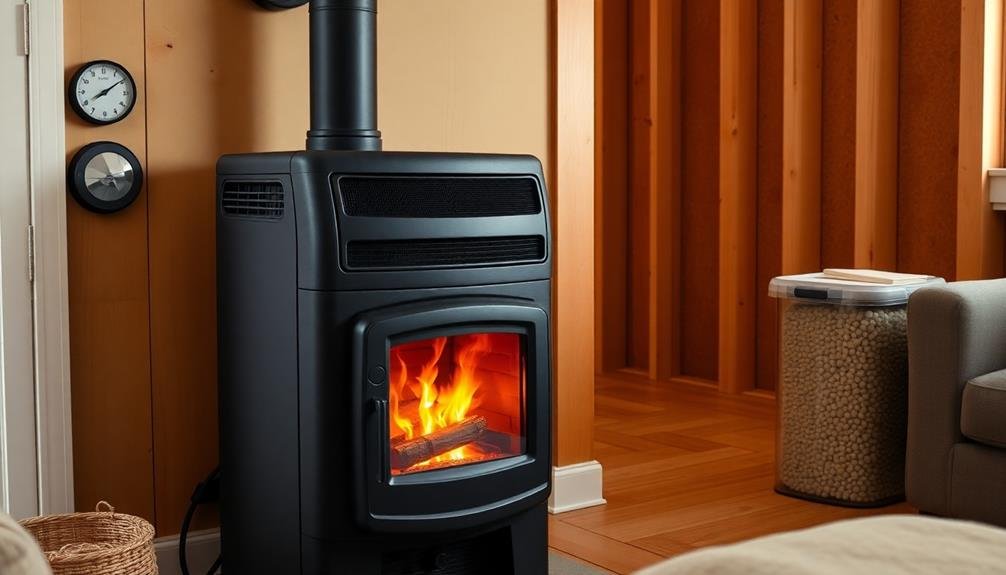
You'll find that several factors can greatly impact your pellet stove's performance.
The quality of fuel you use plays an important role in determining heat output and efficiency.
Regular maintenance and thorough cleaning are also vital to guarantee your stove operates at peak performance.
Fuel Quality Impact
When considering factors that affect pellet stove performance, fuel quality stands out as a crucial element. The type and quality of pellets you use can greatly impact your stove's efficiency, heat output, and overall longevity.
High-quality pellets typically have lower moisture content, fewer impurities, and a more consistent size, leading to better combustion and less ash buildup.
To guarantee you're using the best fuel for your pellet stove:
- Choose pellets with a low ash content (ideally less than 1%) to reduce cleaning frequency and improve heat output.
- Look for pellets made from hardwoods like oak or maple, as they tend to burn hotter and longer than softwood pellets.
- Check for certification labels such as PFI (Pellet Fuels Institute) Standards Program, which assures consistent quality and performance.
You'll notice that premium pellets may cost more upfront, but they'll often save you money in the long run through improved efficiency and reduced maintenance.
It's also essential to store your pellets properly in a dry, cool place to maintain their quality. By prioritizing fuel quality, you'll optimize your pellet stove's performance and enjoy a more comfortable, cost-effective heating experience.
Maintenance and Cleaning
Maintaining your pellet stove is vital for ideal performance and longevity. Regular cleaning and upkeep will guarantee your stove operates efficiently and safely.
You'll need to empty the ash pan weekly during heavy use, and clean the burn pot daily to prevent clinkers from forming. Don't forget to clean the glass door to maintain visibility and aesthetics.
Every month, you should inspect and clean the exhaust system, including the venting pipes and chimney. This prevents dangerous creosote buildup and maintains proper airflow.
You'll also want to clean the auger and hopper to prevent pellet jams.
Annually, it's essential to perform a thorough cleaning of all components. This includes the combustion blower, convection blower, and heat exchanger.
You may want to hire a professional for this deep clean to guarantee all parts are properly serviced.
Remember to check gaskets and seals regularly, replacing them as needed to maintain airtight connections.
Keep an eye on your pellet supply, ensuring you're using high-quality, dry pellets to minimize ash and residue buildup.
Cost-Benefit Analysis
A cost-benefit analysis is essential when considering a pellet stove for your home. You'll need to weigh the initial investment against long-term savings and environmental impact. Pellet stoves typically cost between $1,500 and $3,000, with installation adding another $1,000 to $3,000. However, they're often more efficient than traditional wood stoves and can greatly reduce your heating bills.
To conduct a thorough cost-benefit analysis:
- Calculate your current heating costs and compare them to the estimated costs of running a pellet stove.
- Factor in the cost of pellets, which can vary by region and season but generally range from $200 to $400 per ton.
- Consider the potential increase in your home's value and any available tax credits or rebates for installing energy-efficient appliances.
Remember to account for maintenance costs, including annual professional inspections and regular cleaning.
While pellet stoves require more upkeep than traditional heating systems, their efficiency and lower fuel costs can offset these expenses over time.
Selecting the Right Size
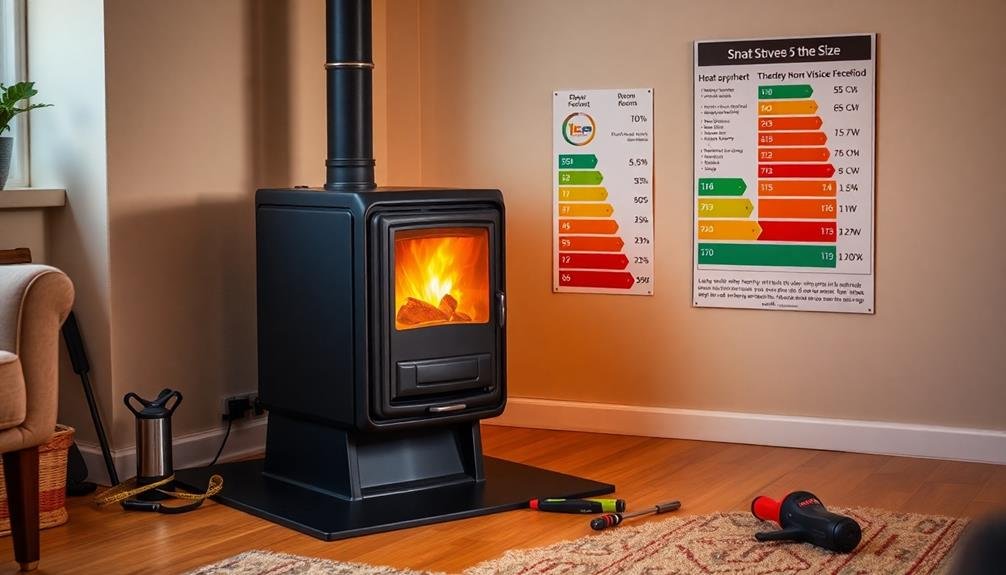
When selecting a pellet stove, you'll need to take into account your heating space requirements, BTU output, and room layout factors.
Start by calculating the square footage you want to heat, as this will directly influence the stove's size and power.
You'll also want to factor in your home's insulation, ceiling height, and the stove's location within the space to guarantee ideal heat distribution.
Calculate Heating Space Requirements
Selecting the right size pellet stove is essential for efficient heating and comfort in your home. To calculate your heating space requirements, you'll need to take into account several factors.
First, measure the square footage of the area you want to heat. This includes all rooms that will benefit from the stove's warmth.
Next, factor in your home's insulation quality and climate zone. A well-insulated house in a moderate climate will require less heating power than a poorly insulated one in a colder region.
You'll also need to account for ceiling height, as higher ceilings mean more space to heat.
Here's a quick guide to help you estimate your heating needs:
- Multiply your square footage by 20 BTUs for a well-insulated home
- Multiply by 30 BTUs for average insulation
- Multiply by 40 BTUs for poor insulation
BTU Output Considerations
Once you've calculated your heating space requirements, it's time to match those needs with the right pellet stove BTU output. BTU, or British Thermal Unit, measures the heat output of a stove. For pellet stoves, this typically ranges from 8,000 to 90,000 BTUs per hour.
As a general rule, you'll need about 30-40 BTUs per square foot of space. However, factors like insulation, ceiling height, and climate can affect this. For a well-insulated 1,000 square foot area, you'd need a stove with 30,000-40,000 BTUs. In colder regions or poorly insulated spaces, aim for the higher end of this range.
Don't be tempted to oversize your stove. A unit that's too powerful will cycle on and off frequently, reducing efficiency and potentially shortening its lifespan. Conversely, an undersized stove won't adequately heat your space.
Consider stoves with adjustable heat output. These allow you to fine-tune the BTU output based on your heating needs, which can vary throughout the season. This flexibility guarantees ideal comfort and efficiency, regardless of outside temperatures or your specific heating requirements.
Room Layout Factors
Room layout plays an important role in selecting the right size pellet stove for your home.
You'll need to take into account the shape, size, and arrangement of the space you're heating to guarantee ideal warmth distribution. A stove that's too small won't adequately heat your room, while an oversized unit may lead to overheating and wasted energy.
When evaluating your room layout, focus on these key factors:
- Open floor plans: If you have an open concept living area, you'll need a larger stove to heat the entire space effectively.
- Multiple rooms: Think about how heat will circulate between rooms if you're planning to warm more than one area.
- Ceiling height: Rooms with high ceilings require more heating power, so you'll need a stove with higher BTU output.
Don't forget to account for insulation quality, window placement, and the number of exterior walls in your heating area.
These elements can greatly impact heat retention and distribution.
It's also vital to measure the square footage of the space you want to heat accurately. This information, combined with your climate zone, will help you determine the appropriate BTU range for your pellet stove.
Proper Installation Techniques
To kick off the installation process, you'll need to carefully plan your pellet stove's location. Verify it's placed on a non-combustible floor pad and maintains proper clearances from walls and furniture.
Next, install a proper venting system, typically a through-the-wall or vertical roof vent, following manufacturer specifications and local building codes.
You'll need to connect the stove to a dedicated electrical outlet, as pellet stoves require electricity to operate. If you're not comfortable with electrical work, hire a licensed electrician.
For the exhaust system, use approved pellet vent piping and follow the recommended pipe diameter and maximum length guidelines.
Don't forget to install a carbon monoxide detector nearby. When positioning the stove, consider ease of maintenance and pellet loading. Confirm there's enough space to clean the unit and access its components.
If you're uncertain about any aspect of the installation, consult a professional. Many regions require permits and inspections for pellet stove installations, so check with your local authorities.
Proper installation is essential for safety, efficiency, and warranty compliance, so take your time and do it right.
Maintenance and Cleaning Tips
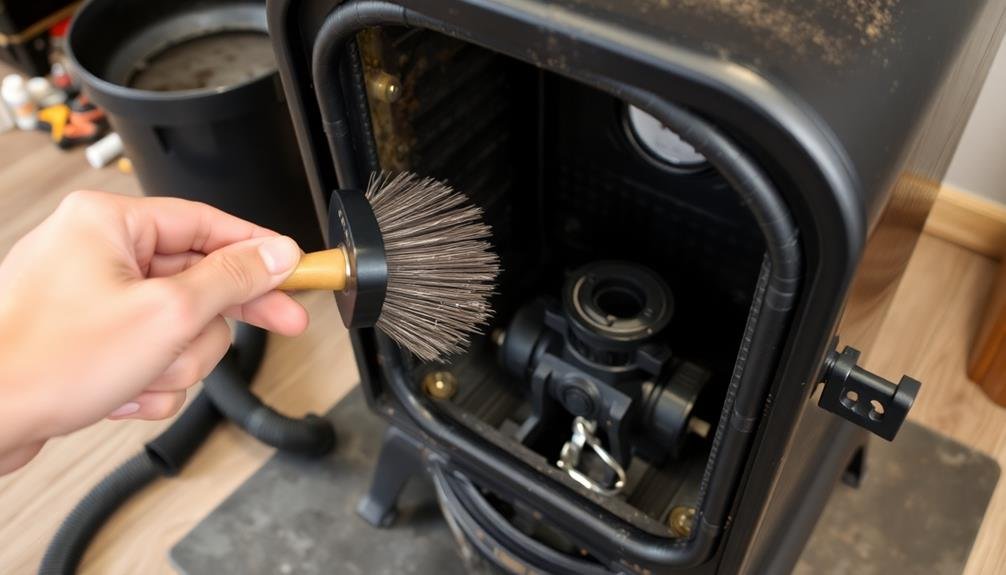
While pellet stoves are relatively low-maintenance, regular upkeep is crucial for peak performance and longevity.
You'll need to perform daily, weekly, and annual maintenance tasks to keep your stove running efficiently. Daily, empty the ash pan and clean the burn pot to prevent clinkers from forming.
Weekly, clean the glass door and wipe down the stove's exterior to maintain its appearance.
For more thorough maintenance, follow these steps:
- Clean the exhaust system annually, removing any built-up creosote or ash to prevent chimney fires and guarantee proper ventilation.
- Inspect and clean the auger and feed system every few months to prevent pellet jams and maintain consistent fuel delivery.
- Check and replace gaskets as needed, typically every 1-2 years, to maintain an airtight seal and peak efficiency.
Don't forget to schedule a professional inspection at least once a year.
They'll check for any hidden issues and perform a deep clean of hard-to-reach components.
Fuel Quality and Selection
Selecting high-quality fuel is vital for your pellet stove's performance and longevity. When choosing pellets, look for those made from pure, dry sawdust or wood shavings. Avoid pellets containing bark, dirt, or other contaminants, as these can reduce efficiency and increase maintenance needs.
Opt for pellets with low moisture content, ideally below 8%. Higher moisture levels can lead to poor combustion and increased creosote buildup. Check the pellet bag for a PFI (Pellet Fuels Institute) certification, which guarantees consistent quality and performance.
Consider the ash content of your pellets. Lower ash content (around 0.5% or less) means less frequent cleanings and reduced wear on your stove. Hardwood pellets typically produce less ash than softwood varieties.
Pay attention to the pellet size and density. Uniform, dense pellets burn more consistently and efficiently. Avoid pellets that are excessively long, short, or crumbly, as they can cause feeding issues.
Lastly, experiment with different brands to find the best fit for your stove. Keep track of how each type performs regarding heat output, ash production, and overall efficiency.
Environmental Impact
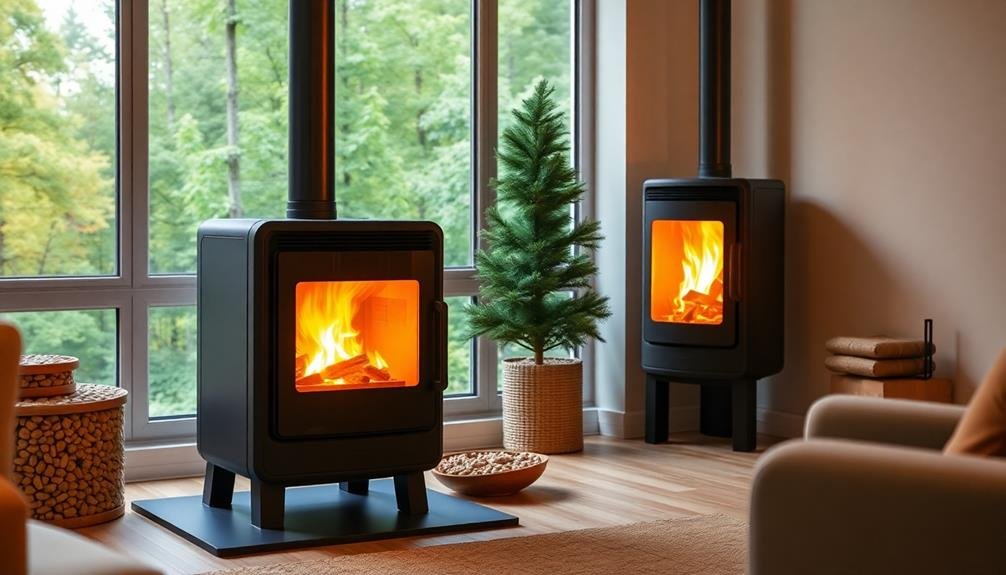
When evaluating the environmental impact of pellet stoves, it's important to weigh both their benefits and drawbacks. On the positive side, pellet stoves are generally more efficient and produce fewer emissions than traditional wood-burning stoves. They burn cleaner, releasing less particulate matter and carbon monoxide into the atmosphere.
However, there are some environmental concerns to keep in mind:
- Pellet production requires energy, which may come from non-renewable sources.
- Transportation of pellets contributes to carbon emissions.
- The manufacturing process of pellet stoves has its own environmental footprint.
Despite these drawbacks, pellet stoves are still regarded as a more environmentally friendly option compared to fossil fuel heating systems. They utilize renewable biomass resources and can help reduce your carbon footprint.
When choosing a pellet stove, look for models with high efficiency ratings and low emissions. You'll also want to reflect on sourcing your pellets locally to minimize transportation impacts.
Safety Considerations
Although pellet stoves offer many benefits, it's important to prioritize safety when using and maintaining them.
Install carbon monoxide detectors in your home and guarantee proper ventilation to prevent dangerous gas buildup. Keep combustible materials at least 36 inches away from the stove and use a protective hearth pad to prevent floor damage.
Regularly clean your pellet stove and inspect it for wear or damage.
Empty the ash pan frequently and dispose of ashes safely in a metal container. Check the venting system for blockages or leaks, and have a professional perform annual maintenance.
When operating your pellet stove, follow the manufacturer's instructions carefully.
Don't overload the hopper or use unauthorized fuel types. Keep children and pets away from the hot surfaces, and never leave the stove unattended while in use.
In case of a malfunction, immediately shut off the stove and unplug it.
Don't attempt to restart it until you've identified and resolved the issue. If you smell smoke or notice unusual noises, evacuate your home and call emergency services.
Comparing Pellet Stoves to Alternatives
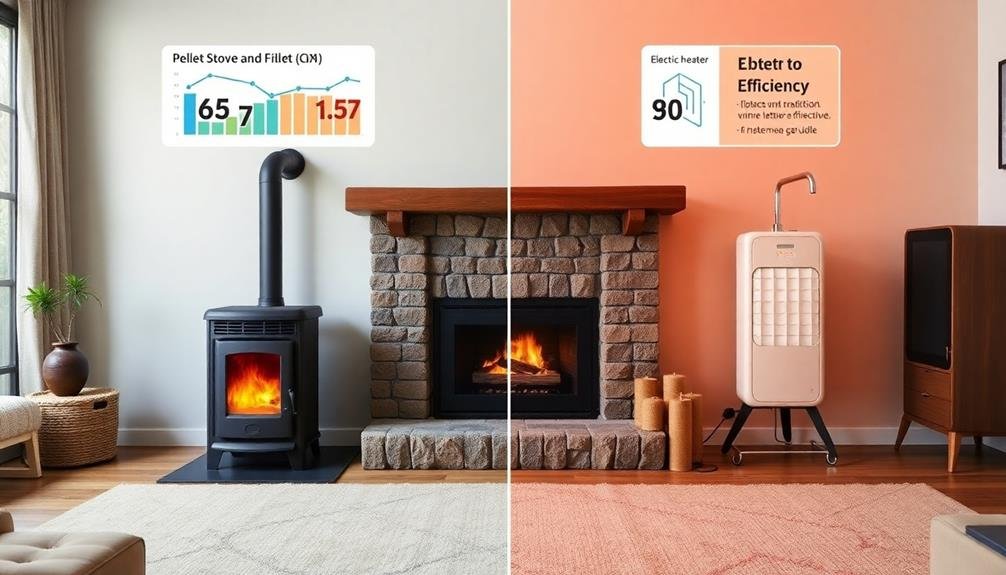
Now that we've covered safety, let's examine how pellet stoves stack up against other heating options. Pellet stoves offer several advantages over traditional wood stoves, gas fireplaces, and electric heaters.
They're more efficient, cleaner-burning, and require less maintenance than wood stoves. Compared to gas fireplaces, pellet stoves provide a more authentic flame experience and don't rely on natural gas lines.
When weighing your options, consider these key factors:
- Efficiency: Pellet stoves boast efficiency ratings of 70-83%, outperforming wood stoves and matching many gas options.
- Fuel costs: Pellets are often cheaper than gas or electricity, potentially lowering your heating bills.
- Environmental impact: Pellet stoves produce fewer emissions than wood stoves and use renewable fuel sources, making them a greener choice.
While pellet stoves have their advantages, they're not perfect.
You'll need to factor in the initial cost, which can be higher than some alternatives. They also require electricity to operate, so you'll need a backup plan during power outages.
Ultimately, your choice will depend on your specific needs, budget, and local fuel availability.
Frequently Asked Questions
Can Pellet Stoves Be Used During Power Outages?
You can't use most pellet stoves during power outages as they rely on electricity. However, some models have battery backups or can be connected to generators. Consider these options if you're worried about losing heat during blackouts.
How Noisy Are Pellet Stoves During Operation?
You'll notice some noise from your pellet stove during operation. It's generally low-level, with a quiet hum and occasional clicking. The fan and auger create most sounds, but they're not typically disruptive to daily activities.
Are Pellet Stoves Suitable for Heating Multiple Rooms or Open Floor Plans?
Yes, pellet stoves can effectively heat multiple rooms or open floor plans. You'll find they're great for distributing warmth throughout larger spaces. Just guarantee you choose the right size and BTU output for your home's layout.
Can Pellet Stoves Be Controlled Remotely or Programmed With Smart Home Devices?
You'll find many modern pellet stoves can be controlled remotely or integrated with smart home systems. You're able to adjust settings, monitor performance, and program schedules using your smartphone or voice-activated devices for added convenience and efficiency.
What Are the Differences Between Wood Pellets and Corn Pellets?
You'll find wood pellets and corn pellets differ in several ways. Wood pellets are made from compressed sawdust, while corn pellets use whole corn kernels. They have different burn rates, ash content, and BTU output. Corn's often cheaper but can be messier.
In Summary
You've now got the knowledge to choose and install a top-rated pellet stove. Remember to evaluate efficiency ratings, size, and fuel quality when making your decision. Don't forget about safety and environmental impact. Weigh the costs and benefits against alternative heating options. With proper installation and maintenance, your pellet stove will provide efficient, eco-friendly warmth for years to come. It's time to enjoy cozy, sustainable heat in your home.



Leave a Reply