
To calculate your thermal curtain energy savings, start by measuring your windows accurately. Determine the U-value and R-value of your curtains to assess their insulation effectiveness. Calculate your current heat loss through windows using the formula: Heat Loss = Area x U-factor x Temperature Difference. Estimate potential savings by comparing heat loss with and without thermal curtains, factoring in usage hours and heating season length. Convert energy savings to cost savings using your current energy rates. Choose the right thermal curtains by considering insulation rating, fabric type, and size. By understanding these factors, you'll be well-equipped to maximize your energy savings and improve your home's comfort.
Understanding Thermal Curtain Benefits
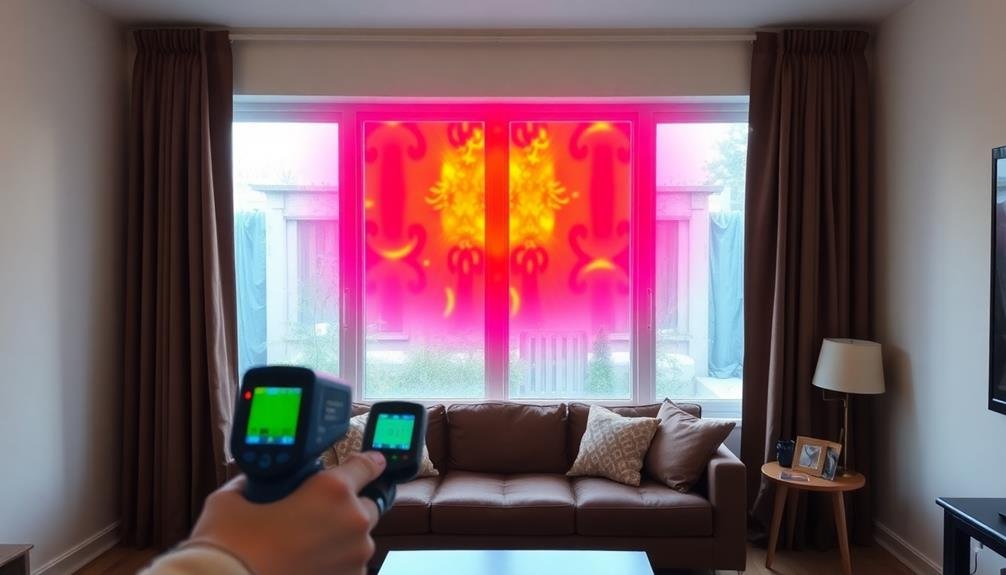
Thermal curtains offer a range of benefits that can greatly impact your home's energy efficiency and comfort.
These specialized window treatments are designed to reduce heat transfer between your living space and the outdoors, effectively insulating your windows. By creating an additional barrier, they minimize heat loss in winter and heat gain in summer, leading to significant energy savings.
You'll notice an immediate improvement in temperature regulation throughout your home. Thermal curtains help maintain a consistent indoor climate, reducing the workload on your heating and cooling systems. This not only lowers your energy bills but also extends the lifespan of your HVAC equipment.
Beyond energy efficiency, thermal curtains provide enhanced light control and noise reduction. They're particularly effective at blocking out unwanted sunlight, making them ideal for bedrooms or media rooms.
The thick, multi-layered fabric also absorbs sound, creating a quieter indoor environment.
Thermal curtains come in various styles and colors, allowing you to improve your home's aesthetics while boosting its energy performance.
You'll find options that seamlessly blend with your existing decor, making it easy to incorporate this energy-saving solution into any room.
Measuring Your Windows
To maximize your thermal curtains' efficiency, you'll need to measure your windows accurately.
Precise window dimensions are essential for selecting curtains that provide ideal coverage and insulation.
Equip yourself with a tape measure, notepad, and pencil to record the width and height of each window frame, ensuring you don't miss any details that could affect your curtains' performance.
Window Dimensions Matter
When it comes to maximizing energy savings with thermal curtains, accurate window measurements are essential. You'll need to measure the width and height of each window, including the frame. Don't forget to account for any protruding elements like handles or locks.
To guarantee a proper fit, measure at three points for both width and height. Use the smallest measurement to ensure your curtains will fit. For bay windows or other unique shapes, you'll need to take additional measurements.
Here's a quick reference guide for measuring different window types:
| Window Type | Width Measurement | Height Measurement | Additional Notes |
|---|---|---|---|
| Standard | Left, center, right | Top, middle, bottom | Use smallest measurement |
| Bay | Each section separately | Each section separately | Measure angles between sections |
| Arched | Widest point | To arch peak | Consider custom curtains |
| French Doors | Include frame | Include frame | Measure each door separately |
| Sliding Glass | Entire opening | Floor to top of frame | Consider overlap for center |
Tools for Accurate Measurement
Precision is key when measuring windows for thermal curtains. To guarantee accurate measurements, you'll need the right tools. Start with a steel tape measure, which provides greater accuracy than fabric or plastic alternatives. It's rigid enough to span larger windows and won't stretch or sag.
For oddly shaped windows, consider using a laser measure. This device uses light to calculate distances, making it ideal for hard-to-reach areas or curved surfaces. It's especially useful for bay windows or arched tops.
Don't forget a notepad and pen to record your measurements. Alternatively, use a smartphone app designed for home measurements. These apps often allow you to sketch your window layout and input dimensions directly.
For extremely precise measurements, particularly in older homes with uneven window frames, a digital caliper can be invaluable. It'll help you account for small variations that could affect curtain fit.
Lastly, invest in a level. This tool guarantees your measurements are straight and aligned, essential for proper curtain hanging.
With these tools at your disposal, you'll be well-equipped to measure your windows accurately for thermal curtains.
Determining U-Value and R-Value
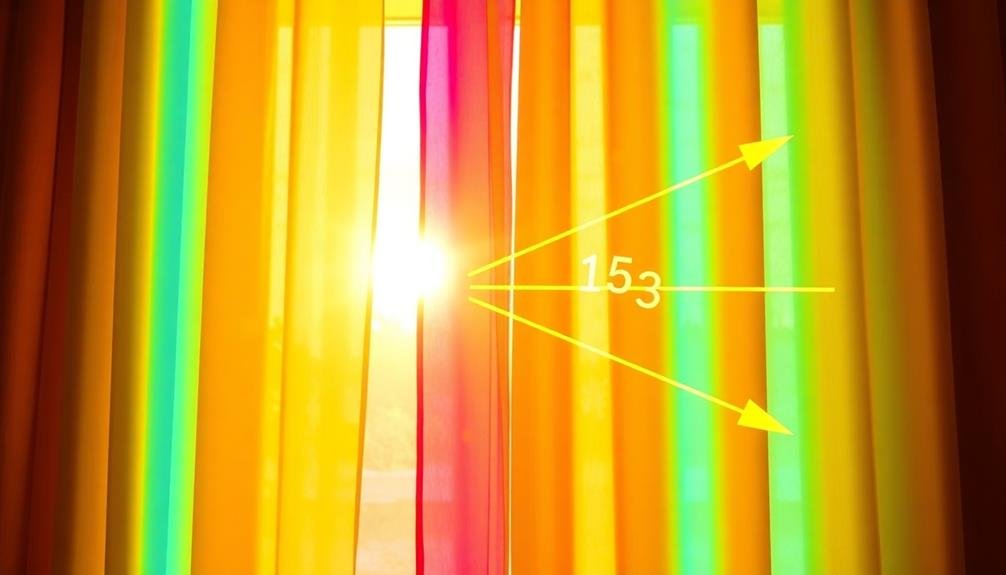
To maximize your thermal curtains' efficiency, you'll need to understand U-value and R-value.
U-value measures heat transfer through a material, while R-value indicates its insulation effectiveness.
Understanding U-Value Basics
Understanding U-value and R-value is essential for analyzing a thermal curtain's energy-saving potential. U-value measures heat transfer through a material, with lower values indicating better insulation. It's expressed in watts per square meter per degree Kelvin (W/m²K). When evaluating thermal curtains, you'll want to look for the lowest U-value possible.
To understand U-value better, reflect on these key points:
- U-value is the inverse of R-value (U = 1/R)
- It accounts for conduction, convection, and radiation heat transfer
- Lower U-values mean less heat loss and better energy efficiency
You'll often see U-values for windows, doors, and other building materials. For thermal curtains, manufacturers may provide U-values or R-values. If you're given an R-value, you can easily convert it to U-value using the inverse relationship.
When comparing thermal curtains, remember that U-value isn't the only factor to evaluate. You'll also want to look at the curtain's material, thickness, and how well it seals against the window frame.
R-Value Calculation Methods
Calculating R-value and U-value for thermal curtains can seem challenging, but it's essential for determining their energy-saving potential.
To calculate R-value, you'll need to know the thickness and thermal conductivity of the curtain material. The formula is R = thickness / thermal conductivity. For multi-layered curtains, add the R-values of each layer.
U-value is the inverse of R-value, so U = 1 / R. You can also calculate U-value directly using the formula U = heat transfer rate / (area × temperature difference). To measure heat transfer rate, you'll need specialized equipment or can refer to manufacturer specifications.
For more accurate results, consider the air gap between the curtain and window. This gap's R-value can noticeably contribute to overall insulation.
Use online calculators or consult energy efficiency experts for precise measurements.
Comparing Insulation Effectiveness
When it comes to comparing insulation effectiveness, you'll need to look at both U-value and R-value. These two measurements provide different perspectives on how well a material insulates. R-value measures thermal resistance, while U-value represents heat transfer rate. The higher the R-value, the better the insulation, whereas a lower U-value indicates superior insulation performance.
To compare insulation effectiveness accurately:
- Calculate both U-value and R-value for each material
- Consider the specific climate and application
- Factor in the thickness of the insulating material
Remember that R-value is the inverse of U-value, so you can easily convert between the two.
For thermal curtains, you'll want to focus on their ability to reduce heat transfer through windows. A higher R-value indicates better insulation properties, meaning your curtains will be more effective at keeping heat inside during winter and outside during summer.
When comparing different thermal curtains or other insulation options, don't rely solely on manufacturer-provided values. Conduct your own calculations using the methods discussed earlier to ascertain accuracy.
This will help you make an informed decision about which insulation solution will provide the best energy savings for your specific situation.
Calculating Heat Loss
Heat loss through windows often accounts for a significant portion of a home's energy waste. To calculate your potential savings with thermal curtains, you'll need to determine your current heat loss. Start by measuring your window's dimensions and identifying its U-factor, which indicates its insulation effectiveness.
Use this formula to calculate heat loss:
Heat Loss (BTU/hr) = Area (sq ft) x U-factor x Temperature Difference (indoor – outdoor)
For example, if you have a 3×5 ft window with a U-factor of 0.5 and a 30°F temperature difference:
Heat Loss = 15 sq ft x 0.5 x 30°F = 225 BTU/hr
Here's a quick reference table for common window sizes and U-factors:
| Window Size (ft) | U-factor 0.3 | U-factor 0.5 | U-factor 0.7 |
|---|---|---|---|
| 3×3 | 81 BTU/hr | 135 BTU/hr | 189 BTU/hr |
| 3×5 | 135 BTU/hr | 225 BTU/hr | 315 BTU/hr |
| 4×6 | 216 BTU/hr | 360 BTU/hr | 504 BTU/hr |
Once you've calculated your heat loss, you can estimate your potential savings by determining how much thermal curtains will reduce this loss. Typically, they can decrease heat loss by 10-25%, depending on their quality and installation.
Estimating Energy Cost Savings

The next step in determining your thermal curtain benefits is estimating the actual cost savings. To do this, you'll need to calculate how much energy you're saving and multiply it by your energy rates.
Start by determining the difference in heat loss between your windows with and without thermal curtains. This value represents the energy saved per hour.
Next, estimate how many hours per day you'll use the curtains and multiply this by the energy saved per hour. This gives you the daily energy savings. Multiply this by the number of days in your heating season to get your annual energy savings.
To convert energy savings to cost savings:
- Find your energy rate (usually in kilowatt-hours for electricity or therms for gas)
- Multiply your annual energy savings by your energy rate
- Add any additional savings from reduced air conditioning needs in summer
Remember that energy rates can vary, so it's best to use your actual rates from recent bills.
You may also want to factor in potential rate increases over time to get a more accurate long-term savings estimate. By following these steps, you'll have a clear picture of your potential cost savings from thermal curtains.
Choosing the Right Thermal Curtains
Now that you've calculated your potential savings, it's time to select the right thermal curtains for your home. Focus on three key factors: insulation rating, fabric type, and size.
Look for curtains with a high R-value, which indicates better insulation. Opt for thick, tightly woven fabrics like velvet, suede, or lined polyester for maximum heat retention.
Ensure your curtains are wide enough to cover the entire window frame and long enough to reach the floor or windowsill. This creates a seal that traps air and prevents heat transfer. Consider curtains with magnetic or Velcro edges to further minimize air leakage.
Color matters too. Dark colors absorb more heat, while light colors reflect it. Choose based on your climate and the room's orientation. For south-facing windows, light colors can help keep rooms cooler in summer.
Don't forget about maintenance. Select curtains that are easy to clean and won't lose their insulating properties after washing. Some thermal curtains are machine washable, while others require dry cleaning.
Balance your budget with long-term energy savings when making your final decision.
Frequently Asked Questions
Can Thermal Curtains Be Used With Existing Window Treatments?
Yes, you can use thermal curtains with existing window treatments. They're versatile and can be layered over blinds or shades. You'll get the benefits of both: thermal insulation and your current window coverings' style and functionality.
How Often Should Thermal Curtains Be Replaced for Optimal Performance?
You should replace your thermal curtains every 5-7 years for best performance. However, if you notice any wear, fading, or reduced insulation, it's best to replace them sooner. Regular maintenance can extend their lifespan.
Do Thermal Curtains Work Equally Well in All Climate Types?
Thermal curtains don't work equally well everywhere. They're most effective in extreme climates. You'll see better results in very cold or hot areas, but they'll still provide some insulation benefits in moderate climates too.
Are There Any Health Concerns Associated With Using Thermal Curtains?
You shouldn't have major health concerns with thermal curtains. They're generally safe, but guarantee proper ventilation to prevent mold growth. If you have allergies, opt for hypoallergenic materials. Always follow manufacturer's cleaning instructions for best results.
Can Thermal Curtains Help Reduce Outside Noise in Addition to Saving Energy?
Yes, thermal curtains can help reduce outside noise. Their thick, multi-layered fabric absorbs sound waves, creating a barrier between your room and external noises. You'll notice a quieter environment in addition to energy savings and improved insulation.
In Summary
You've now got the tools to calculate your potential energy savings from thermal curtains. By understanding your windows' measurements, U-values, and heat loss, you can make an informed decision. Don't forget to evaluate the initial cost of curtains against long-term savings. With the right thermal curtains, you'll not only reduce your energy bills but also enhance your home's comfort. Take action today and start reaping the benefits of a more energy-efficient living space.