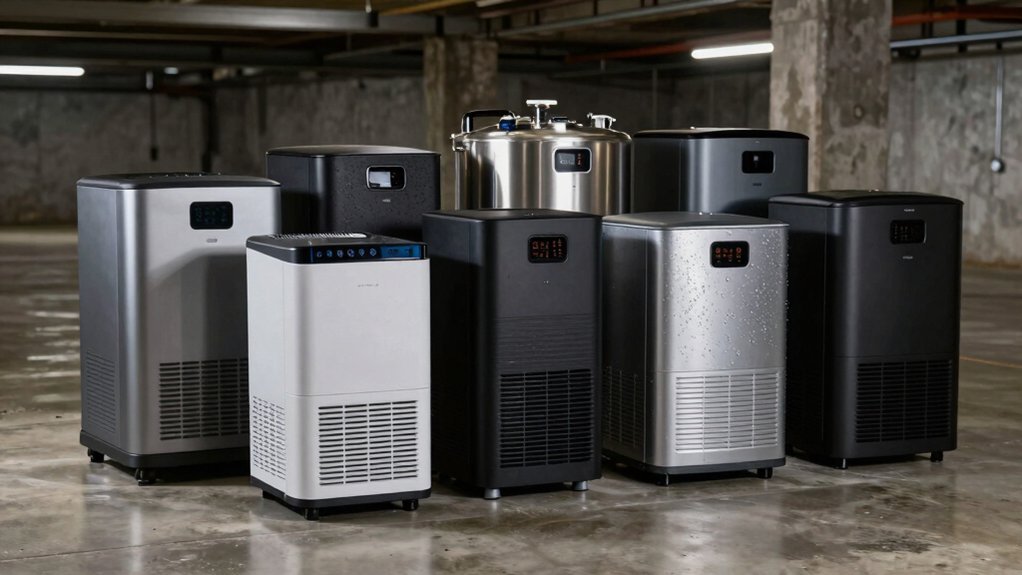

Pick a south‑facing wall that gets full sun all day and avoid any shading. Use dense concrete or fully grouted CMU, at least four inches thick, and paint the interior matte black to boost absorption. Install low‑E glass with a 2‑4‑inch air gap, sealing all edges tightly. Add an overhang to keep summer heat out, and fit a one‑way valve or adjustable shutter to trap warmth at night. Simulate the design for your climate before building, then sync it with your all‑electric HVAC and PV system for optimal balance. Keep reading for more details.
Our Recommended Products On Amazon
Weatherstrip Seal Tape

Duck Brand Self Adhesive Foam Weatherstrip Seal for Extra Large Gaps
Choose a South‑Facing Wall With Full Sun Exposure

Looking for the most efficient way to capture winter sun? Choose a south‑facing wall that enjoys full sun exposure all day. Make sure nothing blocks its path—no trees, overhangs, or neighboring buildings that could cast shadows from sunrise to sunset. Align the glazing so the glass sits in front of a dense, dark‑colored thermal mass, leaving a narrow air gap to trap heat. Use site‑specific sun‑path data or an energy‑modeling tool to verify the wall can store heat for 8–10 hours each day. Prioritize walls built of high‑mass materials like concrete, CMU, or brick, painted dark to boost absorption. This orientation maximizes solar gain, turning your Trombe wall into an efficient heat‑storage chamber for winter comfort.
Use Dense Concrete or CMU for Maximum Thermal Mass
You’ll want a wall that can soak up and hold as much heat as possible, so choose dense concrete or fill CMU blocks to boost mass.
The heavier the wall, the longer it will release stored solar energy, smoothing out temperature swings inside.
Aim for at least four inches of solid material and consider a dark, low‑reflectivity finish to maximize absorption.
High Density Concrete
Maximizing thermal mass starts with dense concrete or CMU, because their higher density stores more heat and dampens temperature swings better than lightweight alternatives. When you choose high‑density concrete for your Trombe wall, you boost thermal mass dramatically. Dark‑colored mixes absorb solar radiation, while a high‑absorptivity backing reduces radiative loss through the glazing. Aim for a wall thickness that balances storage capacity and structural limits—thicker sections hold more heat but demand proper load calculations, especially on retrofits. Pair the mass with a selective coating so the panel’s heat transfers efficiently, delivering 8–12 hours of stored warmth before it releases into interior spaces. This approach ensures the wall captures, retains, and slowly releases solar energy with minimal temperature fluctuation.
CMU Filled for Mass
Dense concrete or fully grouted CMU blocks transform a Trombe wall into a high‑capacity thermal battery, allowing it to absorb solar heat and discharge it over 8–12 hours. When you fill CMU mass, you increase density and thermal mass, so the wall retains heat longer and radiates it steadily into the interior. A dark, low‑gloss finish maximizes absorption, while proper structural checks ensure the added weight doesn’t overload the foundation or floor. Avoid lightweight or air‑entrained CMU if you require quick heat release, because it reduces thermal mass and delays the payoff. The result is a dependable, passive heat reservoir that moderates temperature fluctuations throughout the day.
- Use dense concrete or fully grouted CMU for peak thermal mass.
- Fill CMU cores fully; partial fills waste capacity.
- Apply a dark, matte coating to enhance solar absorption.
- Confirm load‑bearing capacity before adding mass.
- Insulate the exterior glass to keep heat inside the wall.
Paint the Interior Surface a Dark, Low‑Reflectivity Color

Why bother painting the interior of a Trombe wall a dark, low‑reflectivity hue? A dark surface grabs solar energy that a light one would bounce away, and low reflectivity keeps that heat inside instead of sending it back through the glass. Choose a matte charcoal, black, or deep brown paint; the eggshell finish cuts glare while still absorbing. Apply a uniform coat so the wall heats evenly, then let it cure before installing the glazing.
The darker finish raises the wall’s temperature quickly, boosting heat transfer into the thermal mass behind it. Pairing this with a high‑mass wall stores more daytime heat and releases it slowly at night, smoothing indoor temperatures without extra equipment.
Install Low‑E Glass and a Narrow Air Gap for Efficient Heat Capture
Ever considered how a thin layer of Low‑E glass and a snug air gap can turn your Trombe wall into a solar‑heat powerhouse? By using Low‑E glass you cut radiant losses while still catching the sun’s rays, and a narrow gap—just a few inches—keeps heat transfer efficient without letting convection steal it away. Seal the edges tightly to block stack and edge losses, and pair the glazing with a dark, high‑mass wall behind it. This combo slows night‑time cooling, letting stored heat drift into your living space for longer periods.
- Choose Low‑E glass with high solar transmittance.
- Keep the air gap between 2–4 inches.
- Seal all perimeter joints with weather‑stripping.
- Use a dense, dark‑finished concrete or brick wall.
- Verify the gap stays uniform across the whole surface.
Add Overhangs or Shading Devices to Prevent Summer Overheating

How can you keep your Trombe wall from turning your home into a sauna during summer? Install overhangs or shading devices that block high‑angle sun while still letting winter light in. A well‑designed overhang can cut summer exposure by 30‑60 % without sacrificing winter gain. Match the overhang length to your latitude: longer, higher extensions work in hot climates, while shorter, deeper ones suit cooler regions. Use climate analysis—manual or software—to fine‑tune dimensions, ensuring you don’t over‑shade during winter. Pair fixed overhangs with vertical louvers or movable shutters for adjustable control, letting you dial in the right amount of heat year‑round. This simple tweak prevents overheating, keeps indoor temperatures comfortable, and lets your Trombe wall work efficiently across seasons.
Size the Air Space and Vents for Controlled Natural Convection
What gap width will give you both efficient heat capture and a reliable convection loop? Aim for a 1‑to‑2 inch (25‑50 mm) air gap; it’s narrow enough to trap solar heat yet wide enough for buoyant flow. Position vents low on the wall so cool air enters and warm air rises into the interior. Keep the channel clear of obstructions, and use a dense, massive wall behind the gap for 8‑12 hour heat release. Choose operable vents so you can open them on sunny days for stronger convection and close them at night or during mild weather to limit losses.
- 1‑2 in air gap for optimal capture
- Low‑placed vents for intake
- Single‑pass loop, no interior blockages
- High‑mass wall behind gap for storage
- Adjustable vents for seasonal tuning
Seal All Joints and Flashings to Preserve the Passive‑House Envelope
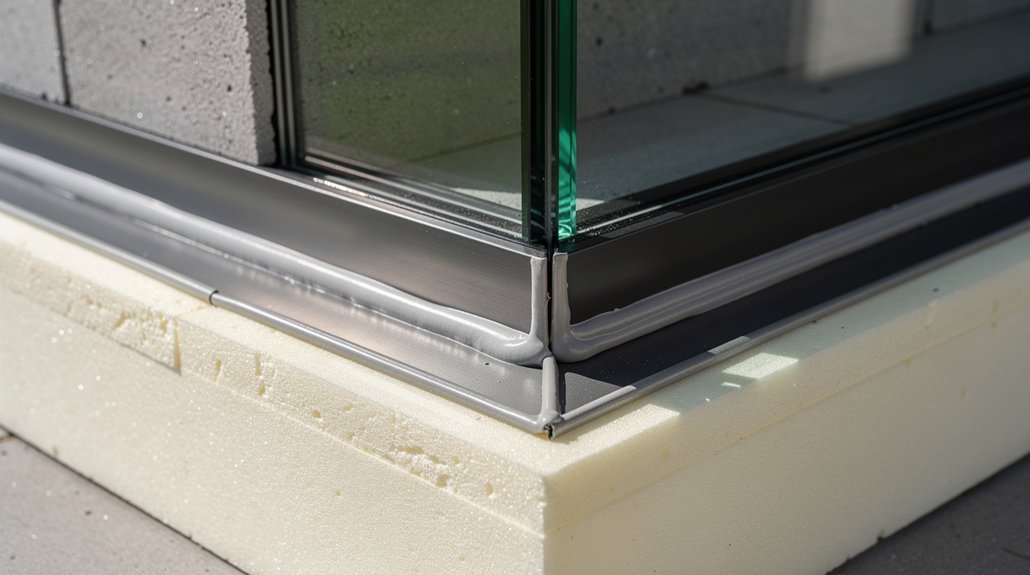
Why let tiny gaps sabotage your passive‑house performance? You must seal every joint and flashing around the Trombe wall to keep the envelope airtight and the thermal mass effective. Use 2‑in. Hannabband expanding‑foam tape on rough openings; it flexes without stressing the wall. Run a continuous bead of sealant at panel‑to‑wall interfaces and glazing edges. Pay special attention where the wall meets roof overhangs and soffits—any draft there kills comfort. After you finish, run a blower‑door test to verify airtightness meets passive‑house standards.
| Area | Recommended Material | Why it matters |
|---|---|---|
| Rough openings | Expanding‑foam tape | Flexible, stress‑free seal |
| Panel‑to‑wall | Continuous sealant | Prevents air leakage |
| Glazing edges | Sealant bead | Maintains thermal mass efficiency |
| Roof overhangs | Flashing sealant | Stops convective drafts |
| Soffits | Flashing sealant | Preserves airtightness |
| Final verification | Blower‑door test | Confirms performance targets |
Incorporate a One‑Way Valve or Adjustable Shutter for Night‑time Heat Retention
Ever considered keeping the day‑time heat inside your Trombe wall while the night air tries to steal it? Installing a one‑way valve or an adjustable shutter lets you lock the warm air in the cavity after sunset, cutting convective losses and preserving 8–12 hours of stored heat. Choose a motorized or manual shutter that seals tightly, fits a weatherproof frame, and can be angled for seasonal sun changes. The valve stops interior air back‑flow, while the shutter blocks night‑time radiation through the glazing. With proper seals, you’ll keep Michigan’s winter chill from leaking into the mass and maintain high daytime gains.
- One‑way valve prevents back‑flow at night
- Adjustable shutter seals the air gap after sunset
- Weather‑proof frame resists winter moisture
- Manual or motorized operation for flexibility
- Seasonal angle adjustment preserves daytime gain
Simulate Performance With Climate‑Specific Software Before Building
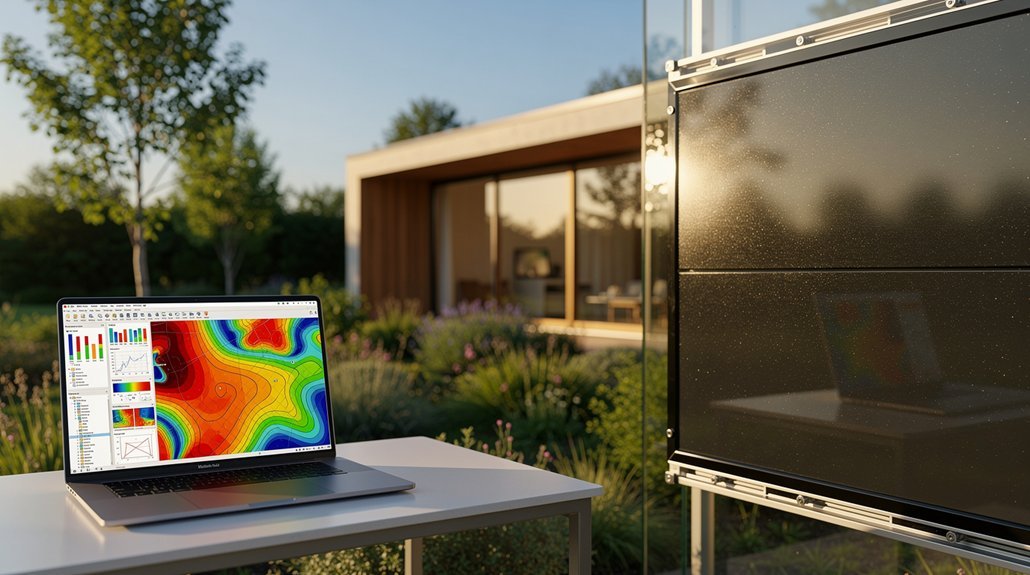
After installing a one‑way valve or adjustable shutter, the next step is to verify that your Trombe wall will actually deliver the expected heat in your climate. Use climate‑specific simulation tools like BLAST to model the south‑facing thermal mass wall before you break ground. Input local sun angles, temperature ranges, and occupancy schedules, then run hourly weather data to capture sun‑angle shifts and cloud cover. Compare variants—different mass density, wall thickness, glazing type, and air‑gap width—to see how each affects solar gain and net heat balance across winter‑summer cycles. Run sensitivity analyses on wall color, coating efficiency, and convection path geometry to pinpoint parameters that extend storage duration and improve delivery to living spaces. Adjust shading or insulation if the model shows negative diurnal balance.
Integrate the Trombe Wall With Your All‑Electric HVAC and PV System for Balanced Energy Use
You’ll want your all‑electric HVAC to follow the Trombe wall’s heat release schedule, so the system stays idle when the wall is delivering warmth.
Your PV array can then offset the remaining load, feeding electricity to the heat pump or ventilation unit during cooler periods.
Smart controls will balance wall output, HVAC operation, and solar generation to keep your energy use steady year‑round.
HVAC Align With HVAC
How can you make your all‑electric HVAC and PV system work hand‑in‑hand with a Trombe wall? Size the radiant mass so it supplements, not replaces, your Mitsubishi M‑Series heat pump, delivering 8–12 hours of stored warmth. Coordinate the southeast roof PV to charge the mass while the heat pump runs, and let the Zehnder HRV recover interior heat during ventilation. Design convection paths that let warm air rise naturally to common areas, cutting auxiliary fan use. Use a building‑management system that monitors sun, mass temperature, and HVAC load to decide when the Trombe preheats versus when the heat pump runs independently.
- Size Trombe walls for 8‑12 hour heat storage
- Sync PV output with mass charging and heat‑pump cycles
- Connect Zehnder HRV for ventilation heat recovery
- Route convection‑driven air to reduce fan reliance
- Deploy real‑time controls for HVAC alignment and load balancing
PV Output Offsets Load
Ever wonder how to let your rooftop PV do the heavy lifting for a Trombe‑wall‑powered house? Size your array for the southeast roof so its PV output aligns with the wall’s peak heat release from midday through afternoon. When the wall stores solar heat, the PV system can offset the heating load, cutting net utility use. Use dedicated monitoring to track consumption during winter heating cycles, ensuring the PV output matches demand. Pair the Trombe wall’s thermal storage with HVAC controls so excess solar energy charges the mass instead of running the electric heater. High‑efficiency HRV and a conditioned basement lower auxiliary loads, improving load offset and keeping your all‑electric system balanced.
Controls Optimize Energy Balance
Integrating the Trombe wall with your all‑electric HVAC and PV system lets you match heat capture with peak solar output, cutting grid dependence on sunny winter days. By coordinating the wall’s thermal mass with PV generation, you pre‑warm rooms before the HVAC kicks in, keeping the system in a low‑energy mode. Active controls—like a blower or HRV—move warm air from the wall during midday peaks and taper off at night, while a smart thermostat monitors indoor setpoints and triggers HVAC override only when the wall’s heat would overshoot. Airtight sealing and selective coatings further reduce losses, ensuring the passive solar gain translates directly into usable energy.
- Schedule heat release to align with PV peaks.
- Use a blower or HRV for mid‑day air circulation.
- Deploy a thermostat that overrides HVAC only when needed.
- Seal the envelope and apply low‑emissivity coating.
- Monitor energy flow in real time to fine‑tune controls.
Frequently Asked Questions
Can a Trombe Wall Work With Double‑Pane Windows?
Yes, you can use double‑pane windows in a Trombe wall, but expect lower heat gain than single glazing; the extra insulation reduces solar absorption, so you may need a larger collector area to compensate.
How Deep Should the Air Gap Be for Optimal Performance?
You should make the air gap about 5 to 10 inches deep; that thickness lets heat circulate efficiently while minimizing thermal losses, giving your trombe wall optimal performance.
Do I Need a Fire‑Rated Barrier Behind the Wall?
You should install a fire‑rated barrier behind the wall; it prevents heat from escaping, meets building codes, and protects against accidental ignition, ensuring safety and prime performance.
Can the Wall Be Insulated on the Exterior Side?
Yes, you can insulate the exterior, but keep the glass clear of insulation to preserve solar gain. Use a thin, vapor‑permeable layer, then a weather‑proof cladding, ensuring the thermal mass stays exposed.
What Maintenance Is Required for the Vent Shutters?
You should inspect the vent shutters monthly, clean any dust or debris, lubricate hinges if they squeak, and check seals for cracks; replace worn parts promptly to keep airflow efficient.
In Summary
By following these ten tips, you’ll turn a simple south‑facing wall into a high‑performance trombe wall that captures winter sun, stores heat, and releases it when you need it. You’ll keep your home comfortable, lower your electric bills, and maximize the return on your PV and HVAC investments—all while staying true to passive‑solar principles. Take the steps now, and watch your energy independence grow.